
Paper List
-
Evolutionarily Stable Stackelberg Equilibrium
通过要求追随者策略对突变入侵具有鲁棒性,弥合了斯塔克尔伯格领导力模型与演化稳定性之间的鸿沟。
-
Recovering Sparse Neural Connectivity from Partial Measurements: A Covariance-Based Approach with Granger-Causality Refinement
通过跨多个实验会话累积协方差统计,实现从部分记录到完整神经连接性的重建。
-
Atomic Trajectory Modeling with State Space Models for Biomolecular Dynamics
ATMOS通过提供一个基于SSM的高效框架,用于生物分子的原子级轨迹生成,弥合了计算昂贵的MD模拟与时间受限的深度生成模型之间的差距。
-
Slow evolution towards generalism in a model of variable dietary range
通过证明是种群统计噪声(而非确定性动力学)驱动了模式形成和泛化食性的演化,解决了间接竞争下物种形成的悖论。
-
Grounded Multimodal Retrieval-Augmented Drafting of Radiology Impressions Using Case-Based Similarity Search
通过将印象草稿基于检索到的历史病例,并采用明确引用和基于置信度的拒绝机制,解决放射学报告生成中的幻觉问题。
-
Unified Policy–Value Decomposition for Rapid Adaptation
通过双线性分解在策略和价值函数之间共享低维目标嵌入,实现对新颖任务的零样本适应。
-
Mathematical Modeling of Cancer–Bacterial Therapy: Analysis and Numerical Simulation via Physics-Informed Neural Networks
提供了一个严格的、无网格的PINN框架,用于模拟和分析细菌癌症疗法中复杂的、空间异质的相互作用。
-
Sample-Efficient Adaptation of Drug-Response Models to Patient Tumors under Strong Biological Domain Shift
通过从无标记分子谱中学习可迁移表征,利用最少的临床数据实现患者药物反应的有效预测。
Collective adsorption of pheromones at the water-air interface
Aix Marseille Univ, CNRS, Centrale Med, IRPHE (UMR 7342), Marseille, France | ICSM, CEA, CNRS, ENSCM, Univ. Montpellier, Marcoule, France | Institut de Recherche sur la Biologie de l’Insecte, UMR 7261, CNRS-Université de Tours, Tours, France


30秒速读
IN SHORT: This paper addresses the core challenge of understanding how amphiphilic pheromones, previously assumed to be transported in the gas phase, can be stabilized and concentrated at the water-air interface of atmospheric aerosols through collective adsorption and a 2D phase transition.
核心创新
- Methodology Presents state-of-the-art all-atom molecular dynamics simulations to construct a full Langmuir adsorption isotherm for a pheromone monolayer, a comprehensive approach rare in the field.
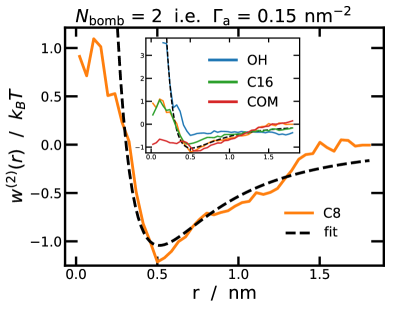
- Biology Quantifies the collective adsorption free energy gain (~2kBT per molecule) for bombykol at the water-air interface, providing a mechanistic explanation for pheromone enrichment on atmospheric aerosols.
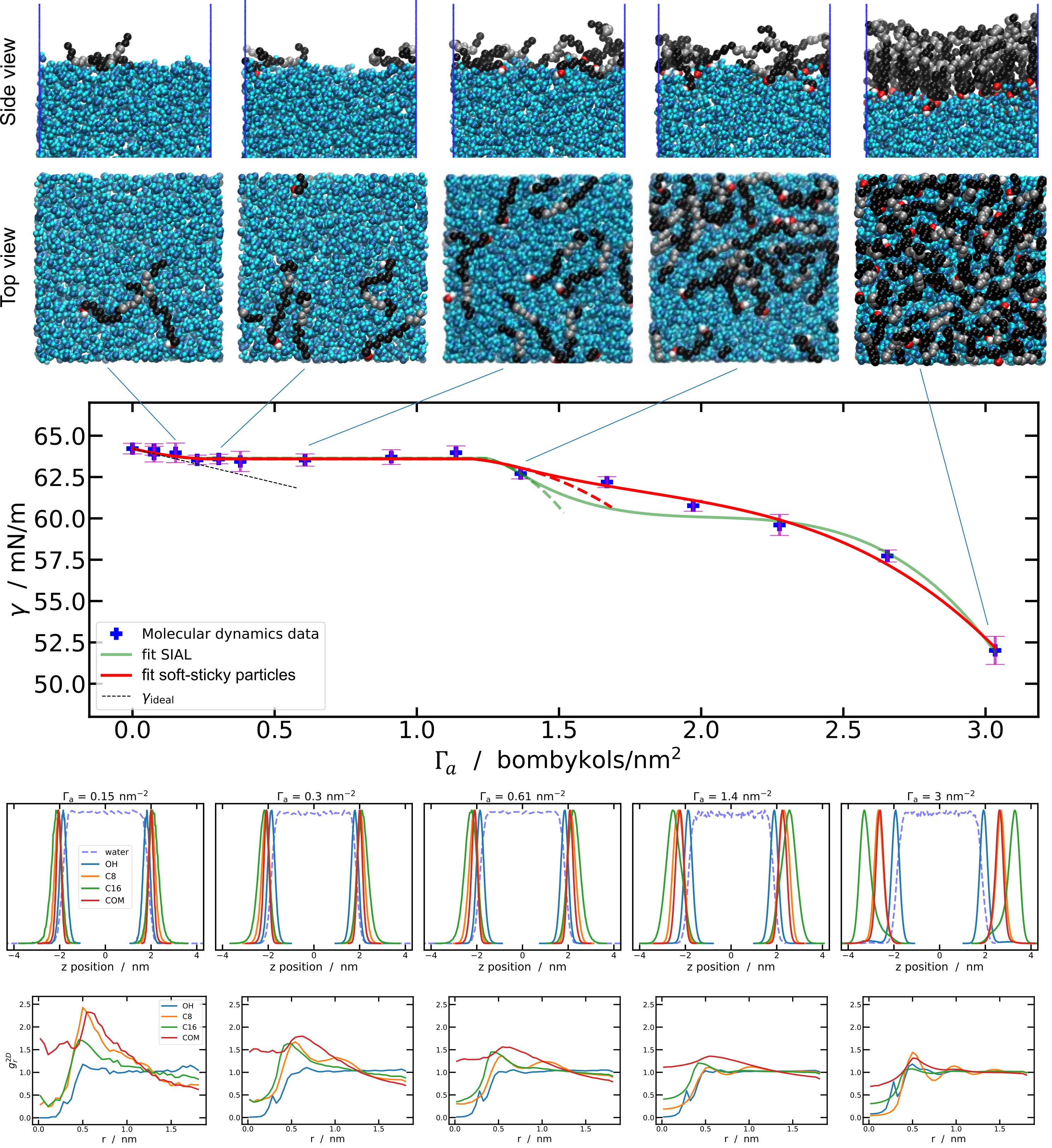
- Theory Identifies and characterizes a two-dimensional liquid-gas phase transition within the pheromone monolayer, modeled successfully with a soft-sticky particle equation of state.
主要结论
- Collective interactions within a bombykol monolayer at the water-air interface provide a stabilization free energy of approximately 2kBT per molecule, significantly enhancing adsorption compared to individual molecules.
- The monolayer exhibits a clear two-dimensional liquid-gas phase transition, accurately described by a soft-sticky particle equation of state, with the transition plateau evident in the surface tension vs. concentration isotherm.
- The calculated adsorption free energy increases under lower estimates of the condensing surface concentration (ΓC), indicating that pheromone adsorption onto aerosols is more favorable in dilute regimes, relevant for atmospheric conditions.
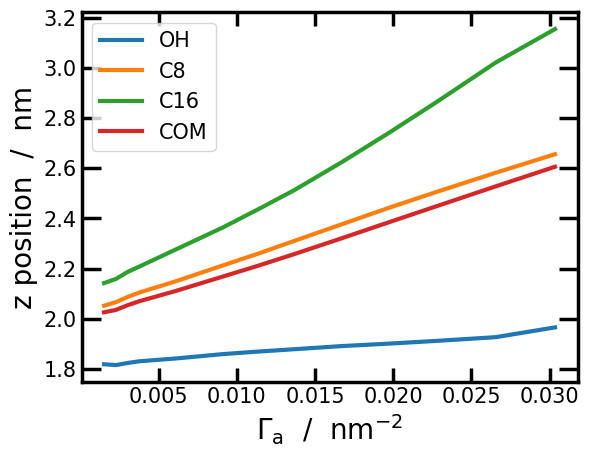
摘要: Understanding the phase behaviour of pheromones and other messaging molecules remains a significant and largely unexplored challenge, even though it plays a central role in chemical communication. Here, we present all-atom molecular dynamics simulations to investigate the behavior of bombykol, a model insect pheromone, adsorbed at the water–air interface. This system serves as a proxy for studying the amphiphilic nature of pheromones and their interactions with aerosol particles in the atmosphere. Our simulations reveal the molecular organization of the bombykol monolayer and its adsorption isotherm. A soft-sticky particle equation of state accurately describes the monolayer’s behavior. The analysis uncovers a two-dimensional liquid–gas phase transition within the monolayer. Collective adsorption stabilises the molecules at the interface and the calculated free energy gain is approximately 2kBT. This value increases under lower estimates of the condensing surface concentration, thereby enhancing pheromone adsorption onto aerosols. Overall, our findings hold broad relevance for molecular interface science, atmospheric chemistry, and organismal chemical communication, particularly in highlighting the critical role of phase transition phenomena.