
Paper List
-
Macroscopic Dominance from Microscopic Extremes: Symmetry Breaking in Spatial Competition
This paper addresses the fundamental question of how microscopic stochastic advantages in spatial exploration translate into macroscopic resource domi...
-
Linear Readout of Neural Manifolds with Continuous Variables
This paper addresses the core challenge of quantifying how the geometric structure of high-dimensional neural population activity (neural manifolds) d...
-
Theory of Cell Body Lensing and Phototaxis Sign Reversal in “Eyeless” Mutants of Chlamydomonas
This paper solves the core puzzle of how eyeless mutants of Chlamydomonas exhibit reversed phototaxis by quantitatively modeling the competition betwe...
-
Cross-Species Transfer Learning for Electrophysiology-to-Transcriptomics Mapping in Cortical GABAergic Interneurons
This paper addresses the challenge of predicting transcriptomic identity from electrophysiological recordings in human cortical interneurons, where li...
-
Uncovering statistical structure in large-scale neural activity with Restricted Boltzmann Machines
This paper addresses the core challenge of modeling large-scale neural population activity (1500-2000 neurons) with interpretable higher-order interac...
-
Realizing Common Random Numbers: Event-Keyed Hashing for Causally Valid Stochastic Models
This paper addresses the critical problem that standard stateful PRNG implementations in agent-based models violate causal validity by making random d...
-
A Standardized Framework for Evaluating Gene Expression Generative Models
This paper addresses the critical lack of standardized evaluation protocols for single-cell gene expression generative models, where inconsistent metr...
-
Single Molecule Localization Microscopy Challenge: A Biologically Inspired Benchmark for Long-Sequence Modeling
This paper addresses the core challenge of evaluating state-space models on biologically realistic, sparse, and stochastic temporal processes, which a...
Emergent Spatiotemporal Dynamics in Large-Scale Brain Networks with Next Generation Neural Mass Models
Universitat de les Illes Balears, Spain | Universitat Politècnica de Catalunya, Barcelona, Spain | Institut de Matemàtiques de la UPC - Barcelona Tech (IMTech), Barcelona, Spain | Centre de Recerca Matemàtica, Barcelona, Spain
30秒速读
IN SHORT: This work addresses the core challenge of understanding how complex, brain-wide spatiotemporal patterns emerge from the interaction of biophysically detailed local dynamics and empirical anatomical connectivity.
核心创新
- Methodology Introduces a next-generation neural mass model (NG-NMM) into a large-scale brain network framework, providing a more biophysically grounded and analytically tractable description of population-level gamma oscillations via the PING mechanism.
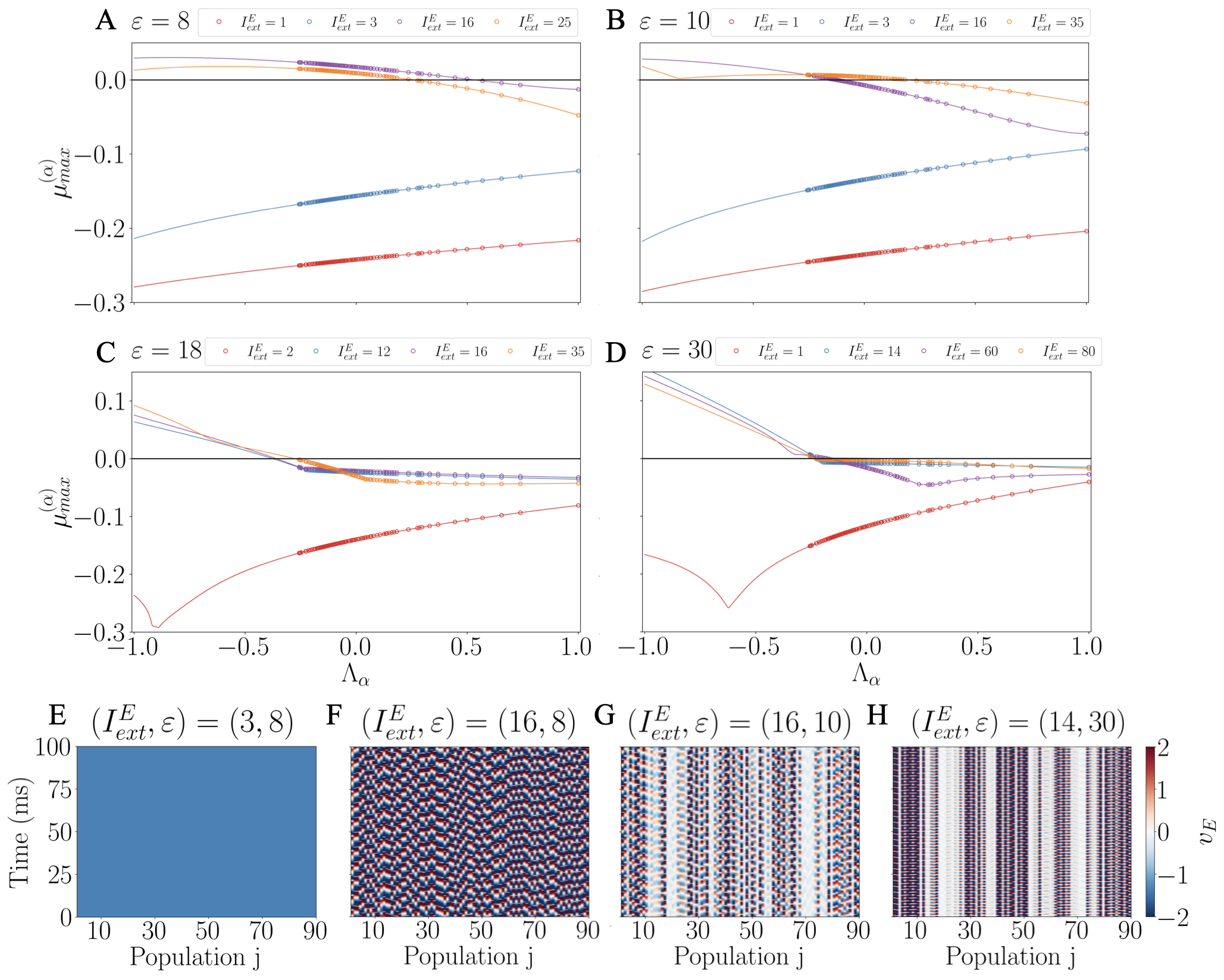
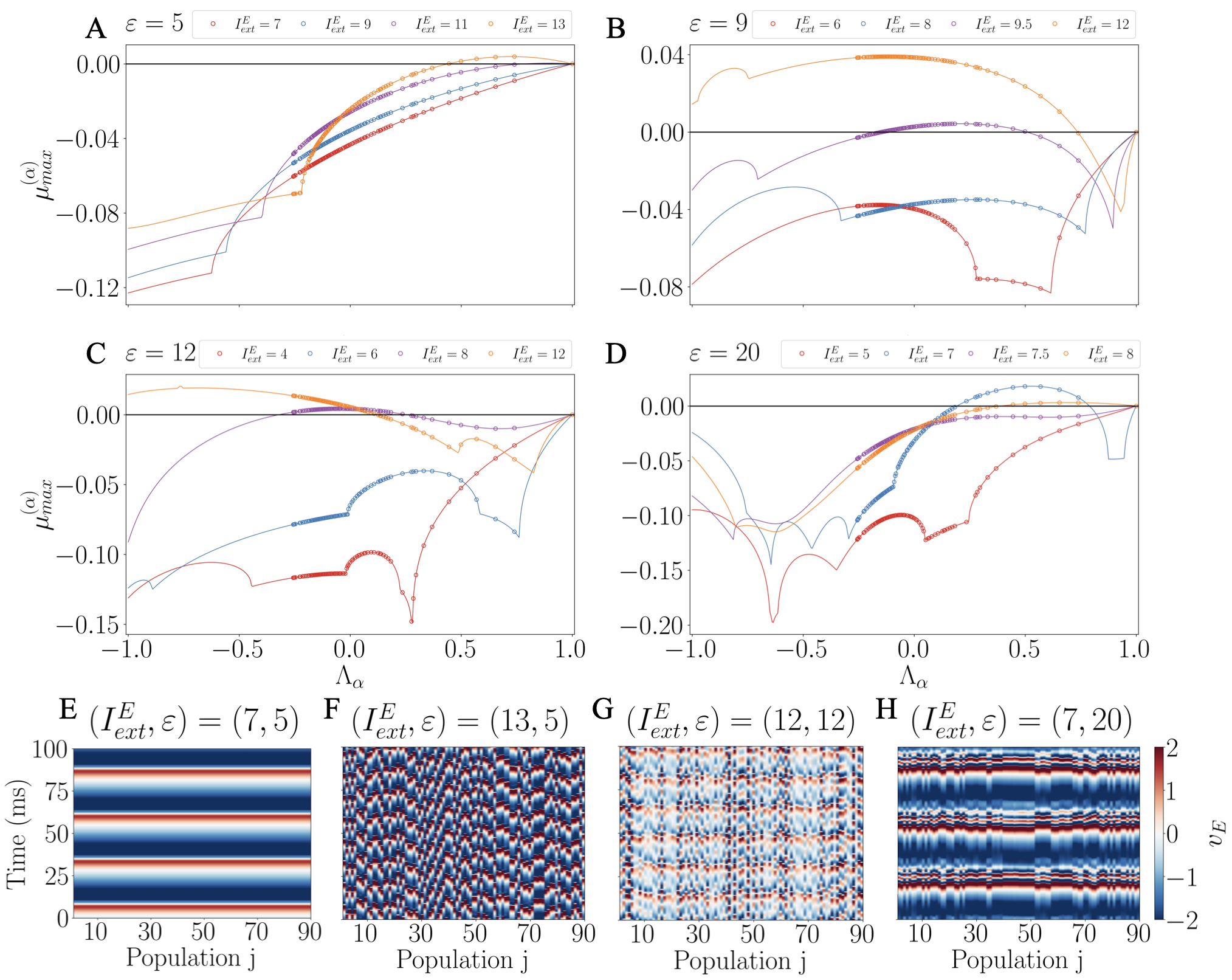
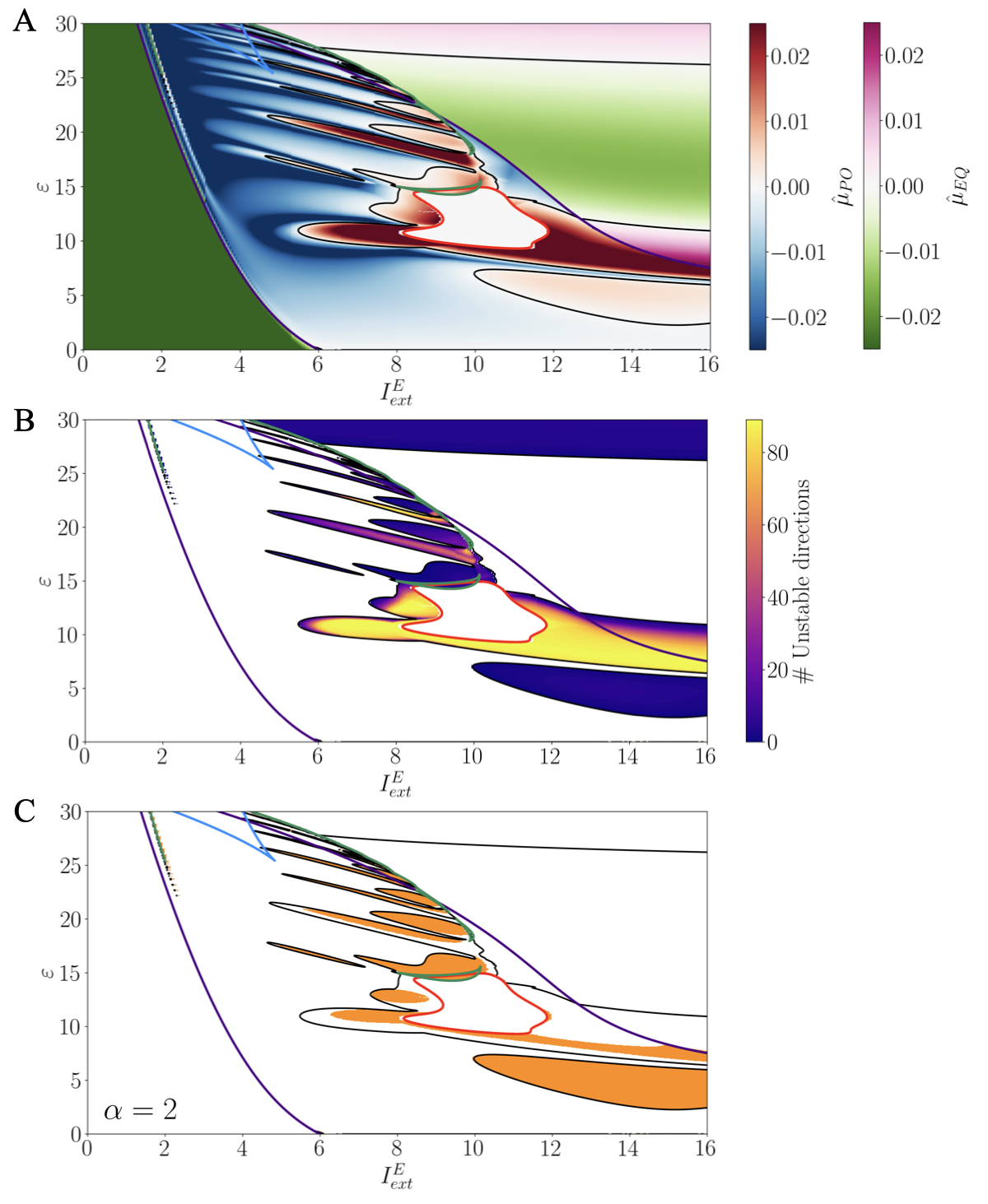
- Methodology Applies the Master Stability Function (MSF) formalism and Floquet theory to systematically analyze transverse instabilities of homogeneous states (both fixed points and limit cycles) in a high-dimensional (90-node) network, linking instability modes to emergent spatiotemporal patterns.
- Biology Demonstrates that the network coupling in NG-NMMs enables cross-frequency coupling (CFC), specifically generating gamma oscillations whose amplitude is modulated by slower rhythms—a phenomenon not possible in isolated nodes and highly relevant for cognitive functions like memory.
主要结论
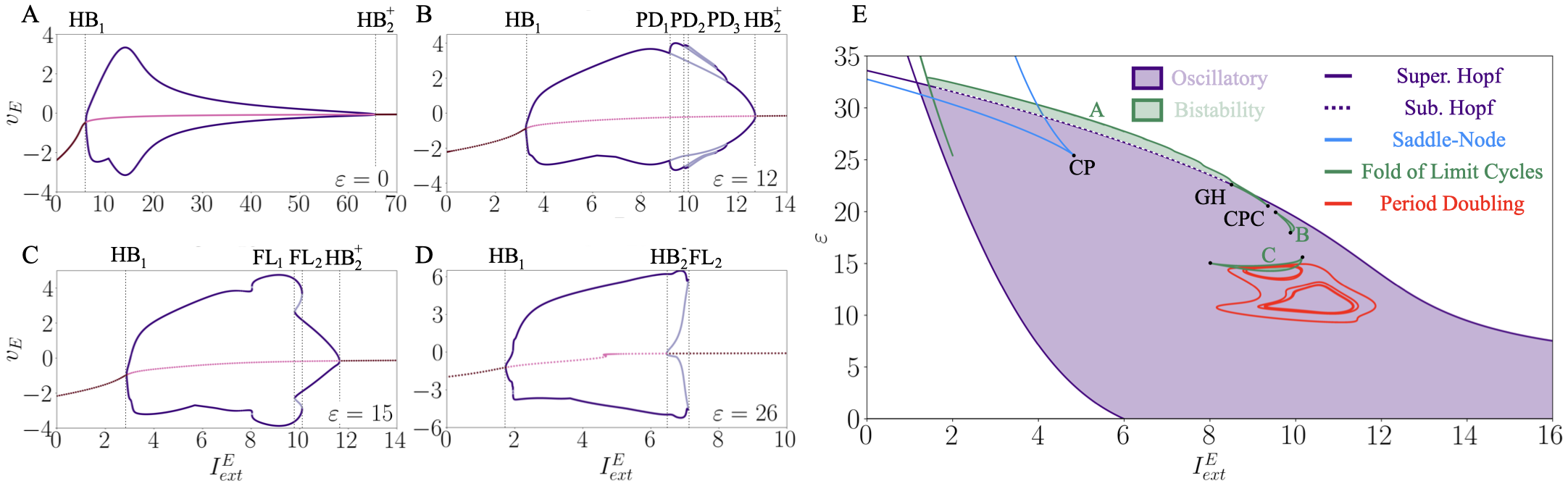
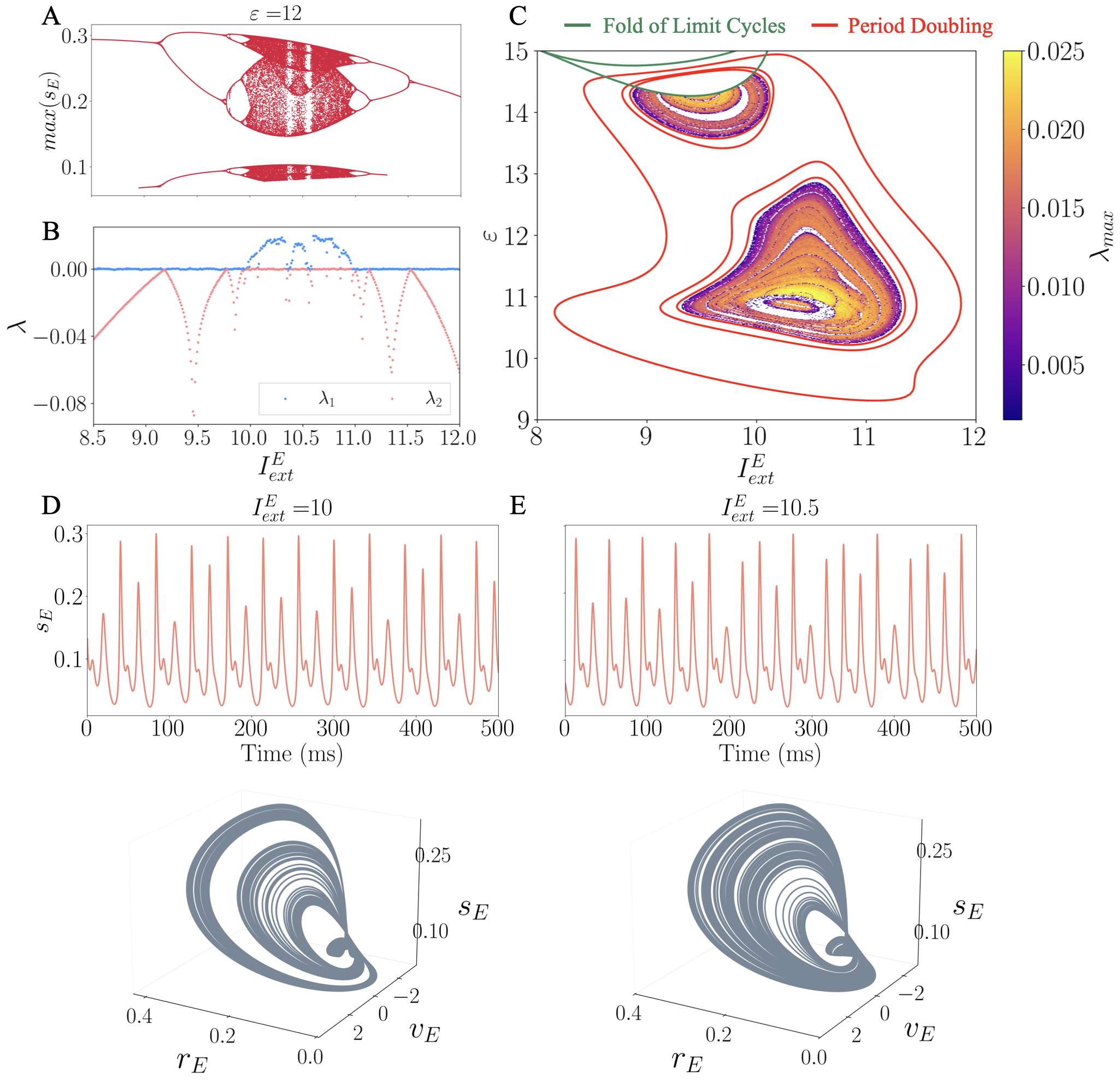
- NG-NMMs exhibit a broader dynamical repertoire than classical models, including regions of bistability, period-doubling cascades, and deterministic chaos within the homogeneous manifold (e.g., positive Lyapunov exponents for I_ext^E ~10-10.5 at ε=12).
- Anatomical connectivity is crucial for inducing cross-frequency coupling, allowing the emergence of gamma oscillations (27-170 Hz) with amplitude modulated by slower rhythms, a key feature of brain dynamics.
- The system's rich spatiotemporal patterns (traveling waves, high-dimensional chaos) arise from transverse instabilities of homogeneous solutions, analytically predicted by the MSF and confirmed via Lyapunov exponent and frequency spectrum analysis.
摘要: Understanding the dynamics of large-scale brain models remains a central challenge due to the inherent complexity of these systems. In this work, we explore the emergence of complex spatiotemporal patterns in a large scale-brain model composed of 90 interconnected brain regions coupled through empirically derived anatomical connectivity. An important aspect of our formulation is that the local dynamics of each brain region are described by a next-generation neural mass model, which explicitly captures the macroscopic gamma activity of coupled excitatory and inhibitory neural populations (PING mechanism). We first identify the system’s homogeneous states—both resting and oscillatory—and analyze their stability under uniform perturbations. Then, we determine the stability against non-uniform perturbations by obtaining dispersion relations for the perturbation growth rate. This analysis enables us to link unstable directions of the homogeneous solutions to the emergence of rich spatiotemporal patterns, that we characterize by means of Lyapunov exponents and frequency spectrum analysis. Our results show that, compared to previous studies with classical neural mass models, next-generation neural mass models provide a broader dynamical repertoire, both within homogeneous states and in the heterogeneous regime. Additionally, we identify a key role for anatomical connectivity in cross-frequency coupling, allowing for the emergence of gamma oscillations with amplitude modulated by slower rhythms. These findings suggest that such models are not only more biophysically grounded but also particularly well-suited to capture the full complexity of large-scale brain dynamics. Overall, our study advances the analytical understanding of emerging spatiotemporal patterns in whole-brain models.