
Paper List
-
A Unified Variational Principle for Branching Transport Networks: Wave Impedance, Viscous Flow, and Tissue Metabolism
This paper solves the core problem of predicting the empirically observed branching exponent (α≈2.7) in mammalian arterial trees, which neither Murray...
-
Household Bubbling Strategies for Epidemic Control and Social Connectivity
This paper addresses the core challenge of designing household merging (social bubble) strategies that effectively control epidemic risk while maximiz...
-
Empowering Chemical Structures with Biological Insights for Scalable Phenotypic Virtual Screening
This paper addresses the core challenge of bridging the gap between scalable chemical structure screening and biologically informative but resource-in...
-
A mechanical bifurcation constrains the evolution of cell sheet folding in the family Volvocaceae
This paper addresses the core problem of why there is an evolutionary gap in species with intermediate cell numbers (e.g., 256 cells) in Volvocaceae, ...
-
Bayesian Inference in Epidemic Modelling: A Beginner’s Guide Illustrated with the SIR Model
This guide addresses the core challenge of estimating uncertain epidemiological parameters (like transmission and recovery rates) from noisy, real-wor...
-
Geometric framework for biological evolution
This paper addresses the fundamental challenge of developing a coordinate-independent, geometric description of evolutionary dynamics that bridges gen...
-
A multiscale discrete-to-continuum framework for structured population models
This paper addresses the core challenge of systematically deriving uniformly valid continuum approximations from discrete structured population models...
-
Whole slide and microscopy image analysis with QuPath and OMERO
使QuPath能够直接分析存储在OMERO服务器中的图像而无需下载整个数据集,克服了大规模研究的本地存储限制。
Emergent Spatiotemporal Dynamics in Large-Scale Brain Networks with Next Generation Neural Mass Models
Universitat de les Illes Balears, Spain | Universitat Politècnica de Catalunya, Barcelona, Spain | Institut de Matemàtiques de la UPC - Barcelona Tech (IMTech), Barcelona, Spain | Centre de Recerca Matemàtica, Barcelona, Spain
30秒速读
IN SHORT: This work addresses the core challenge of understanding how complex, brain-wide spatiotemporal patterns emerge from the interaction of biophysically detailed local dynamics and empirical anatomical connectivity.
核心创新
- Methodology Introduces a next-generation neural mass model (NG-NMM) into a large-scale brain network framework, providing a more biophysically grounded and analytically tractable description of population-level gamma oscillations via the PING mechanism.
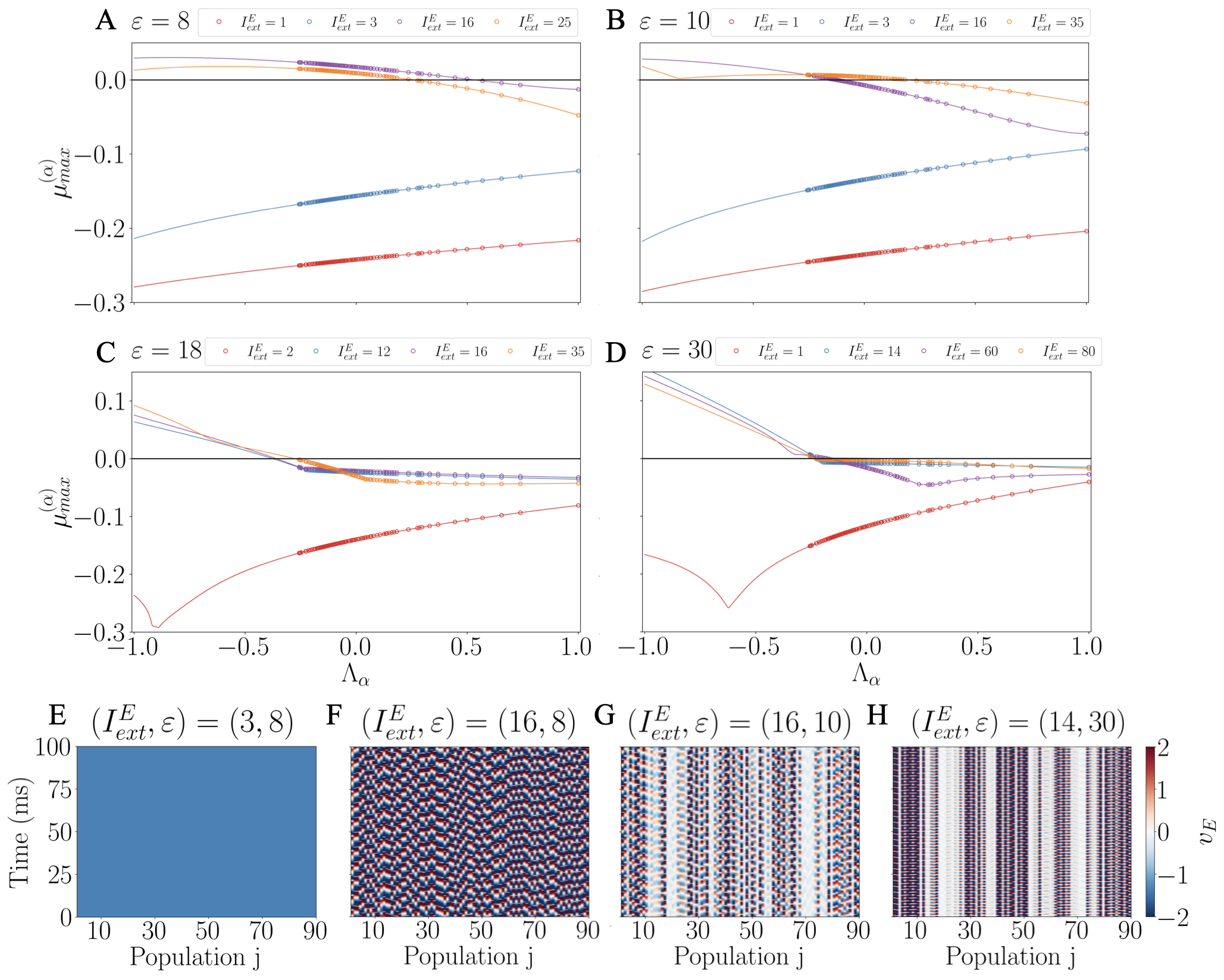
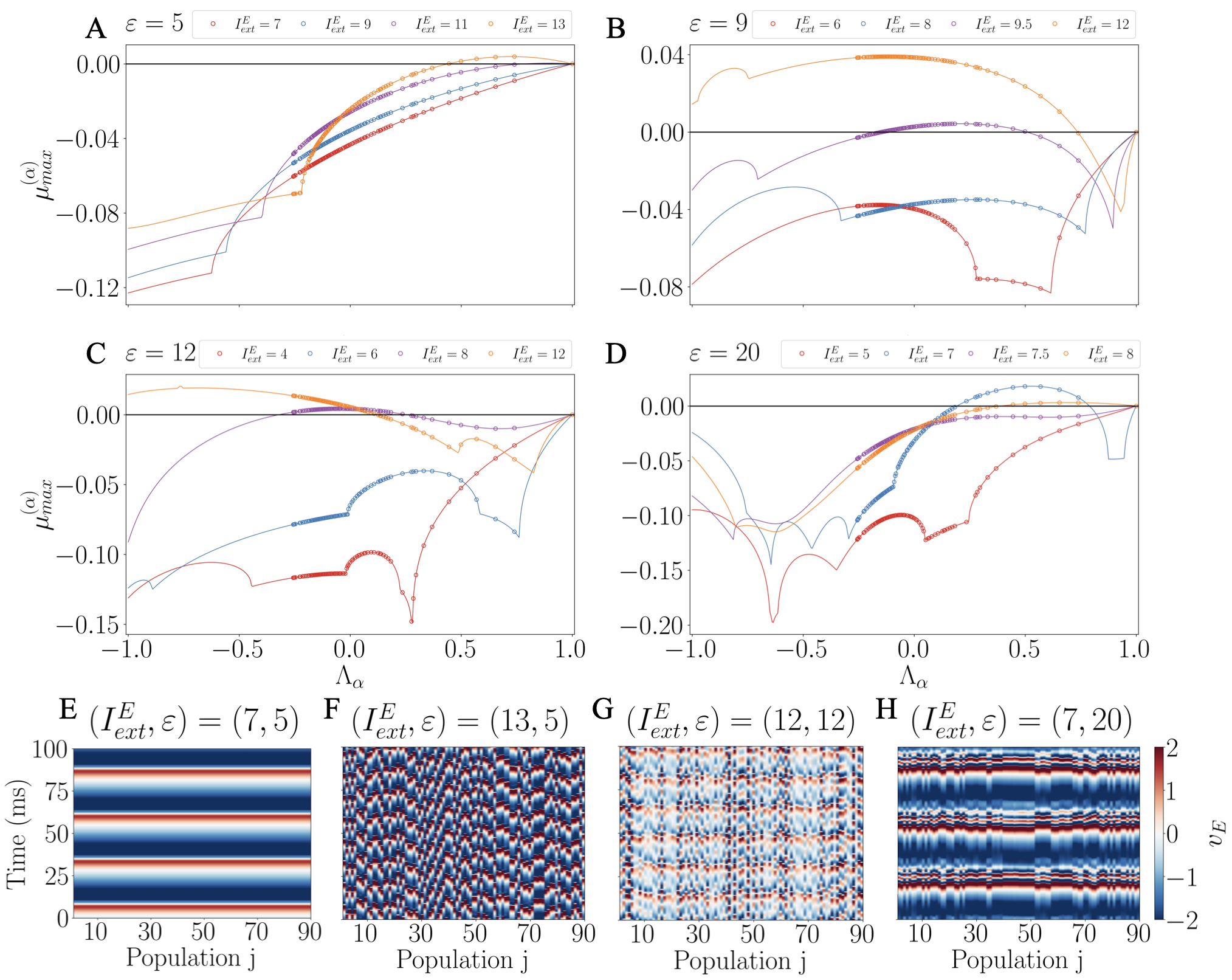
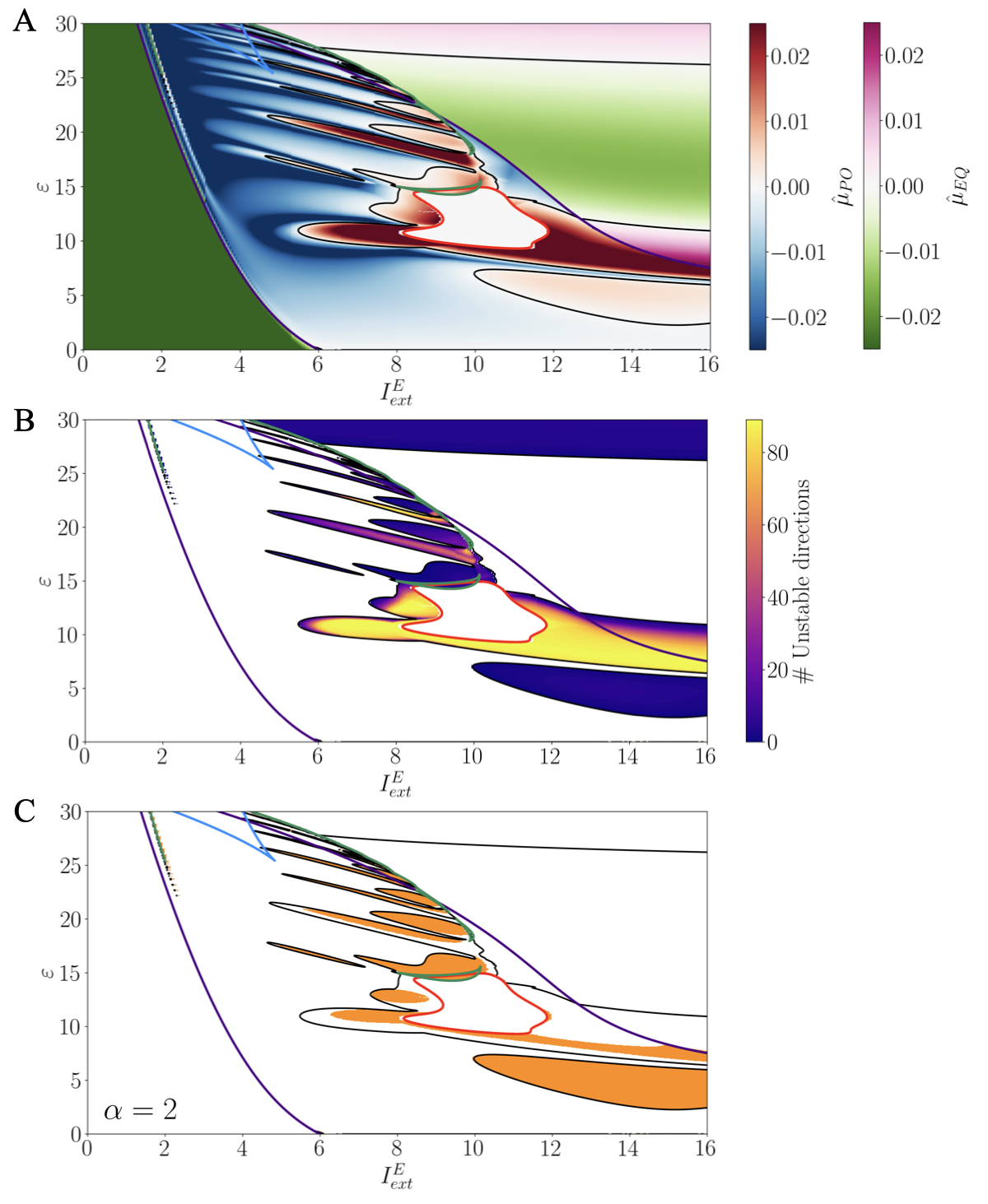
- Methodology Applies the Master Stability Function (MSF) formalism and Floquet theory to systematically analyze transverse instabilities of homogeneous states (both fixed points and limit cycles) in a high-dimensional (90-node) network, linking instability modes to emergent spatiotemporal patterns.
- Biology Demonstrates that the network coupling in NG-NMMs enables cross-frequency coupling (CFC), specifically generating gamma oscillations whose amplitude is modulated by slower rhythms—a phenomenon not possible in isolated nodes and highly relevant for cognitive functions like memory.
主要结论
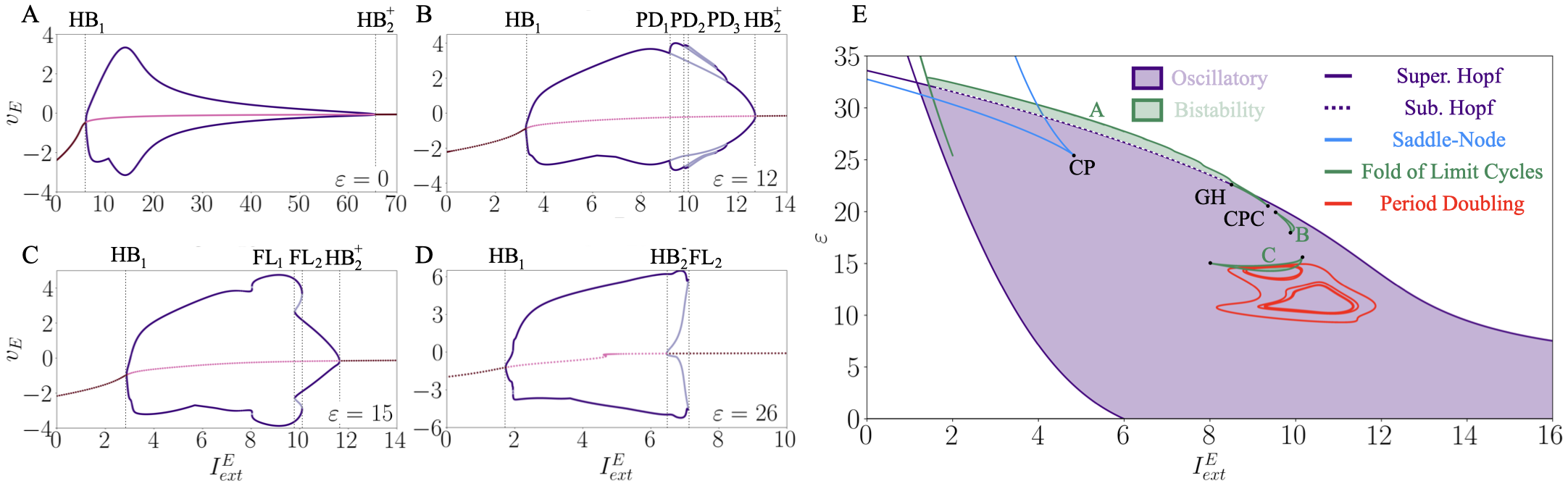
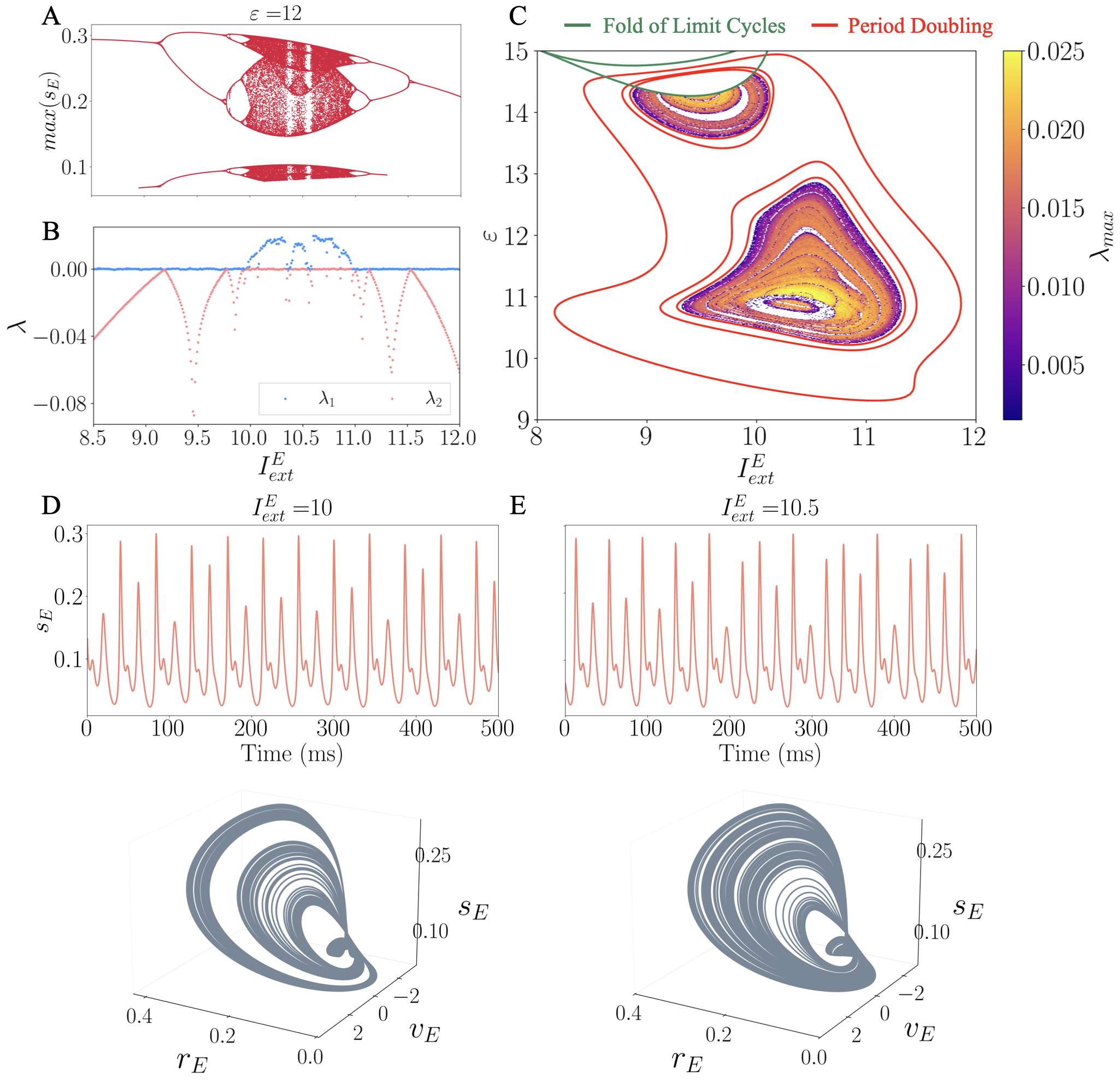
- NG-NMMs exhibit a broader dynamical repertoire than classical models, including regions of bistability, period-doubling cascades, and deterministic chaos within the homogeneous manifold (e.g., positive Lyapunov exponents for I_ext^E ~10-10.5 at ε=12).
- Anatomical connectivity is crucial for inducing cross-frequency coupling, allowing the emergence of gamma oscillations (27-170 Hz) with amplitude modulated by slower rhythms, a key feature of brain dynamics.
- The system's rich spatiotemporal patterns (traveling waves, high-dimensional chaos) arise from transverse instabilities of homogeneous solutions, analytically predicted by the MSF and confirmed via Lyapunov exponent and frequency spectrum analysis.
摘要: Understanding the dynamics of large-scale brain models remains a central challenge due to the inherent complexity of these systems. In this work, we explore the emergence of complex spatiotemporal patterns in a large scale-brain model composed of 90 interconnected brain regions coupled through empirically derived anatomical connectivity. An important aspect of our formulation is that the local dynamics of each brain region are described by a next-generation neural mass model, which explicitly captures the macroscopic gamma activity of coupled excitatory and inhibitory neural populations (PING mechanism). We first identify the system’s homogeneous states—both resting and oscillatory—and analyze their stability under uniform perturbations. Then, we determine the stability against non-uniform perturbations by obtaining dispersion relations for the perturbation growth rate. This analysis enables us to link unstable directions of the homogeneous solutions to the emergence of rich spatiotemporal patterns, that we characterize by means of Lyapunov exponents and frequency spectrum analysis. Our results show that, compared to previous studies with classical neural mass models, next-generation neural mass models provide a broader dynamical repertoire, both within homogeneous states and in the heterogeneous regime. Additionally, we identify a key role for anatomical connectivity in cross-frequency coupling, allowing for the emergence of gamma oscillations with amplitude modulated by slower rhythms. These findings suggest that such models are not only more biophysically grounded but also particularly well-suited to capture the full complexity of large-scale brain dynamics. Overall, our study advances the analytical understanding of emerging spatiotemporal patterns in whole-brain models.