
Paper List
-
Discovery of a Hematopoietic Manifold in scGPT Yields a Method for Extracting Performant Algorithms from Biological Foundation Model Internals
This work addresses the core challenge of extracting reusable, interpretable, and high-performance biological algorithms from the opaque internal repr...
-
MS2MetGAN: Latent-space adversarial training for metabolite–spectrum matching in MS/MS database search
This paper addresses the critical bottleneck in metabolite identification: the generation of high-quality negative training samples that are structura...
-
Toward Robust, Reproducible, and Widely Accessible Intracranial Language Brain-Computer Interfaces: A Comprehensive Review of Neural Mechanisms, Hardware, Algorithms, Evaluation, Clinical Pathways and Future Directions
This review addresses the core challenge of fragmented and heterogeneous evidence that hinders the clinical translation of intracranial language BCIs,...
-
Less Is More in Chemotherapy of Breast Cancer
通过纳入细胞周期时滞和竞争项,解决了现有肿瘤-免疫模型的过度简化问题,以定量比较化疗方案。
-
Fold-CP: A Context Parallelism Framework for Biomolecular Modeling
This paper addresses the critical bottleneck of GPU memory limitations that restrict AlphaFold 3-like models to processing only a few thousand residue...
-
Open Biomedical Knowledge Graphs at Scale: Construction, Federation, and AI Agent Access with Samyama Graph Database
This paper addresses the core pain point of fragmented biomedical data by constructing and federating large-scale, open knowledge graphs to enable sea...
-
Predictive Analytics for Foot Ulcers Using Time-Series Temperature and Pressure Data
This paper addresses the critical need for continuous, real-time monitoring of diabetic foot health by developing an unsupervised anomaly detection fr...
-
Hypothesis-Based Particle Detection for Accurate Nanoparticle Counting and Digital Diagnostics
This paper addresses the core challenge of achieving accurate, interpretable, and training-free nanoparticle counting in digital diagnostic assays, wh...
Vessel Network Topology in Molecular Communication: Insights from Experiments and Theory
Friedrich-Alexander-Universität Erlangen-Nürnberg (FAU)
30秒速读
IN SHORT: This work addresses the critical lack of experimentally validated channel models for molecular communication within complex vessel networks, which is a prerequisite for designing reliable biomedical applications.
核心创新
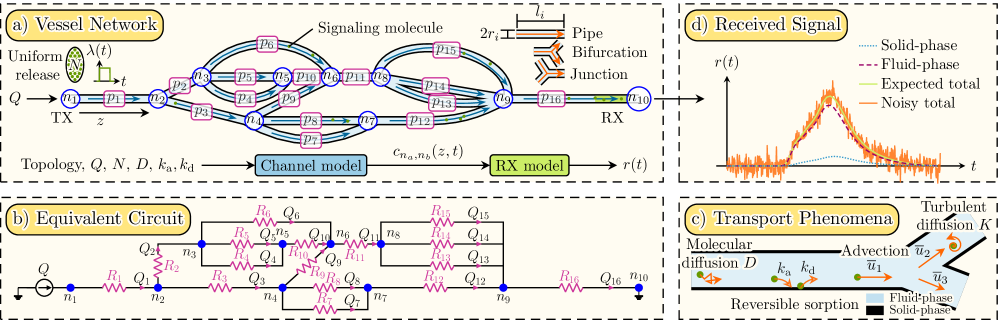
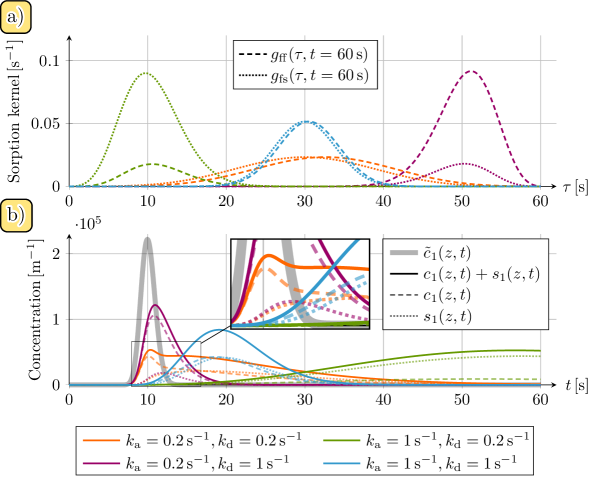
- Methodology Proposes a novel, comprehensive channel model for molecular communication in vessel networks, incorporating advection, molecular/turbulent diffusion, and adsorption/desorption at vessel walls.
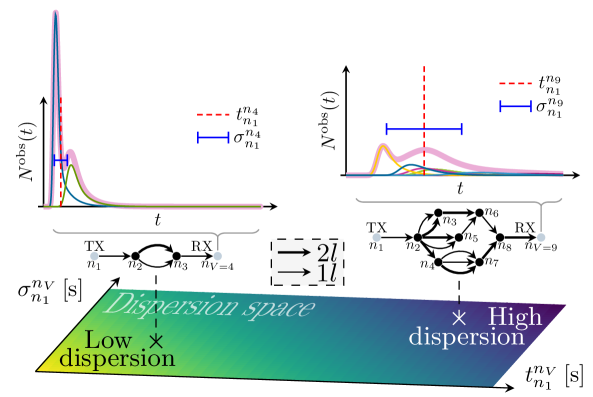
- Methodology Introduces two novel metrics—molecule delay and multi-path spread—to quantify the impact of vessel network topology on signal dispersion and the resulting signal-to-noise ratio (SNR).
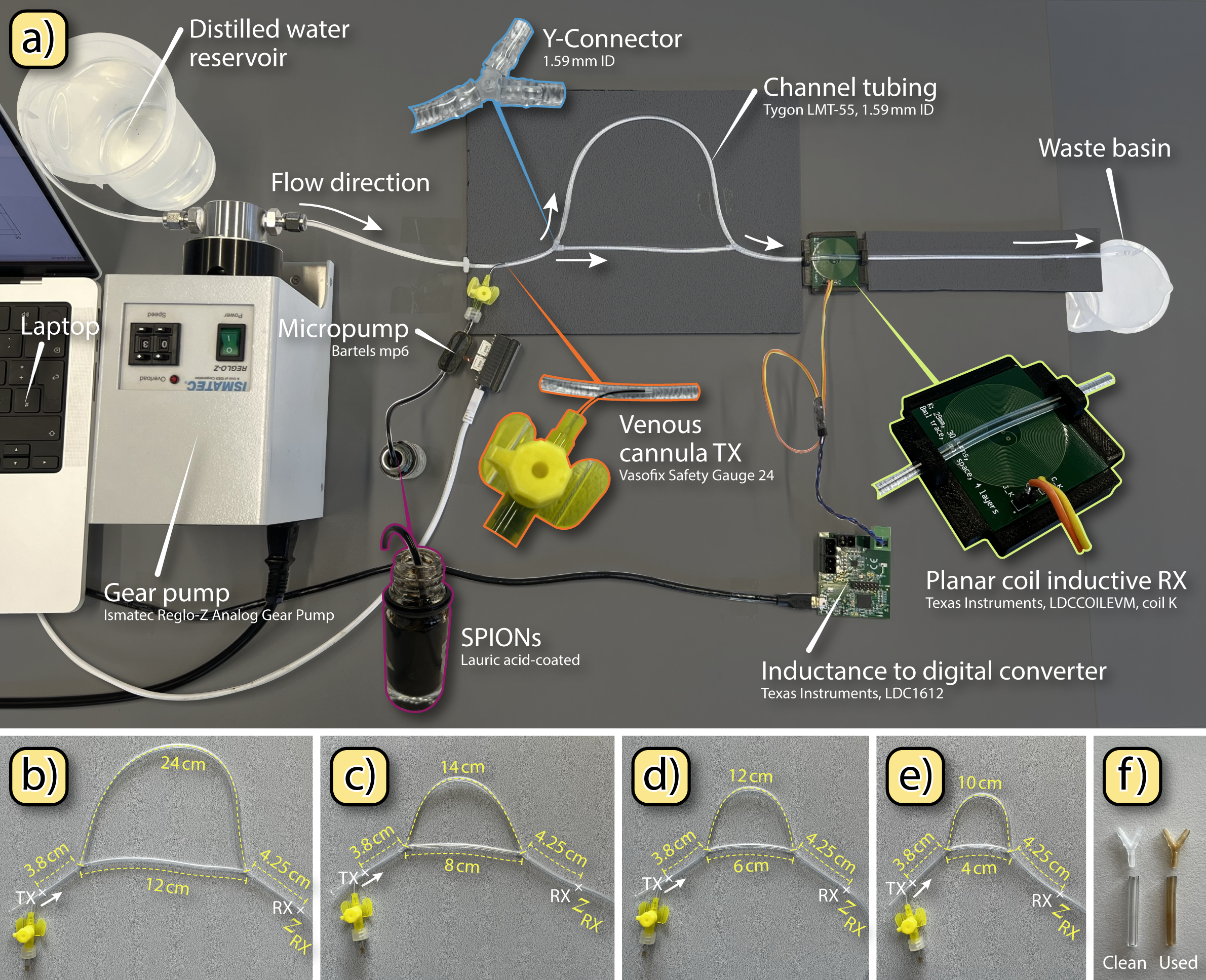
- Methodology Provides the first end-to-end experimental validation of a molecular communication model in branched vessel network topologies using a dedicated SPION (superparamagnetic iron-oxide nanoparticle) testbed.
主要结论
- The proposed channel model, validated against experimental data from branched topologies, accurately captures key transport dynamics (advection, diffusion, sorption) in vessel networks.
- The introduced metrics (molecule delay, multi-path spread) successfully establish a quantifiable link between vessel network structure and the resulting signal-to-noise ratio (SNR) at the receiver.
- The framework enables practical applications such as optimizing sensor placement in the cardiovascular system under specific SNR constraints and guiding the design of experimental testbeds.
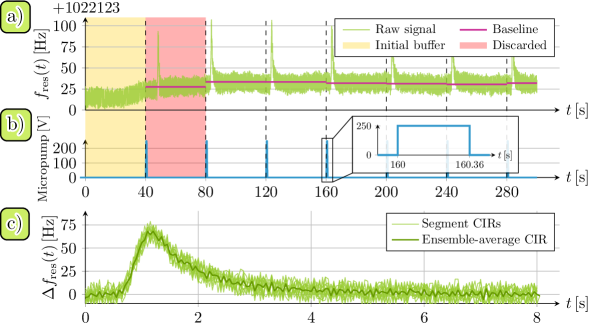
摘要: The notion of synthetic molecular communication (MC) refers to the transmission of information via signaling molecules and is foreseen to enable innovative medical applications in the human cardiovascular system (CVS). Crucially, the design of such applications requires accurate and experimentally validated channel models that characterize the propagation of signaling molecules, not just in individual blood vessels, but in complex vessel networks, as prevalent in the CVS. However, experimentally validated models for MC in VNs remain scarce. To address this gap, we propose a novel channel model for MC in complex VN topologies, which captures molecular transport via advection, molecular and turbulent diffusion, as well as adsorption and desorption at the vessel walls. We specialize this model for superparamagnetic iron-oxide nanoparticles as signaling molecules by introducing a new receiver (RX) model for planar coil inductive sensors, enabling end-to-end experimental validation with a dedicated SPION testbed. Validation covers a range of channel topologies, from single-vessel topologies to branched VNs with multiple paths between transmitter (TX) and RX. Additionally, to quantify how the VN topology impacts signal quality, and inspired by multi-path propagation models in conventional wireless communications, we introduce two metrics, namely molecule delay and multi-path spread. We show that these metrics link the VN structure to molecule dispersion induced by the VN and mediately to the resulting signal-to-noise ratio (SNR) at the RX. The proposed VN structure-SNR link is validated experimentally, demonstrating that the proposed framework can support tasks such as optimal sensor placement in the CVS or the identification of suitable testbed topologies for specific SNR requirements. All experimental data are openly available on Zenodo.