
Paper List
-
Discovery of a Hematopoietic Manifold in scGPT Yields a Method for Extracting Performant Algorithms from Biological Foundation Model Internals
This work addresses the core challenge of extracting reusable, interpretable, and high-performance biological algorithms from the opaque internal repr...
-
MS2MetGAN: Latent-space adversarial training for metabolite–spectrum matching in MS/MS database search
This paper addresses the critical bottleneck in metabolite identification: the generation of high-quality negative training samples that are structura...
-
Toward Robust, Reproducible, and Widely Accessible Intracranial Language Brain-Computer Interfaces: A Comprehensive Review of Neural Mechanisms, Hardware, Algorithms, Evaluation, Clinical Pathways and Future Directions
This review addresses the core challenge of fragmented and heterogeneous evidence that hinders the clinical translation of intracranial language BCIs,...
-
Less Is More in Chemotherapy of Breast Cancer
通过纳入细胞周期时滞和竞争项,解决了现有肿瘤-免疫模型的过度简化问题,以定量比较化疗方案。
-
Fold-CP: A Context Parallelism Framework for Biomolecular Modeling
This paper addresses the critical bottleneck of GPU memory limitations that restrict AlphaFold 3-like models to processing only a few thousand residue...
-
Open Biomedical Knowledge Graphs at Scale: Construction, Federation, and AI Agent Access with Samyama Graph Database
This paper addresses the core pain point of fragmented biomedical data by constructing and federating large-scale, open knowledge graphs to enable sea...
-
Predictive Analytics for Foot Ulcers Using Time-Series Temperature and Pressure Data
This paper addresses the critical need for continuous, real-time monitoring of diabetic foot health by developing an unsupervised anomaly detection fr...
-
Hypothesis-Based Particle Detection for Accurate Nanoparticle Counting and Digital Diagnostics
This paper addresses the core challenge of achieving accurate, interpretable, and training-free nanoparticle counting in digital diagnostic assays, wh...
Emergent Bayesian Behaviour and Optimal Cue Combination in LLMs
Huawei Noah’s Ark Lab, London, UK | AI Centre, Department of Computer Science, University College London, London, UK
30秒速读
IN SHORT: This paper addresses the critical gap in understanding whether LLMs spontaneously develop human-like Bayesian strategies for processing uncertain information, revealing that high accuracy does not guarantee robust multimodal integration.
核心创新
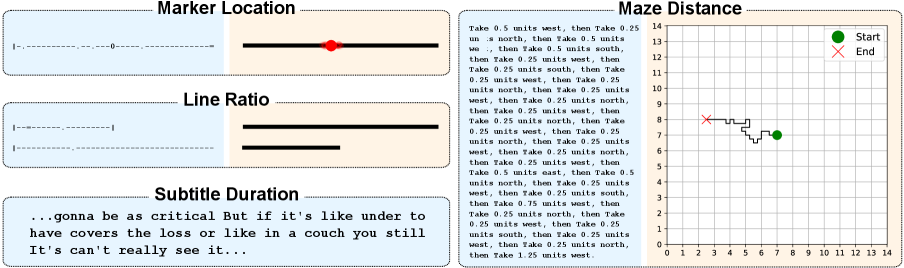
- Methodology Introduces BayesBench, the first psychophysics-inspired behavioral benchmark for LLMs with four magnitude estimation tasks (length, location, distance, duration) across text and image modalities.
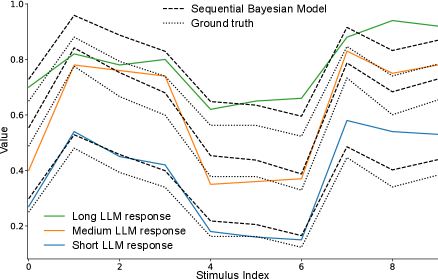
- Methodology Develops Bayesian Consistency Score (BCS) to detect Bayes-consistent behavioral shifts even when accuracy saturates, enabling separation of capability from computational strategy.
- Biology Demonstrates emergent Bayesian behavior in capable LLMs without explicit training, with Llama-4 Maverick showing cue-combination efficiency exceeding human biological systems (RRE > 1 against Bayesian oracle).
主要结论
- GPT-5 Mini achieves perfect text accuracy (NRMSE ≈ 0) but fails to integrate visual cues efficiently, showing poor cue-combination efficiency (RRE < 1) despite high capability.
- Llama-4 Maverick demonstrates emergent Bayesian behavior with cue-combination efficiency exceeding Bayesian reliability-weighted baselines (RRE > 1), suggesting non-linear integration strategies.
- Bayesian Consistency Score reveals that more accurate models show stronger evidence of Bayesian behavior, with BCS positively correlated with accuracy across nine evaluated LLMs.
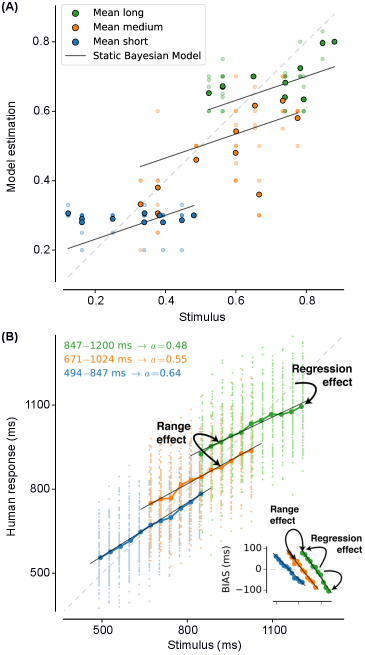
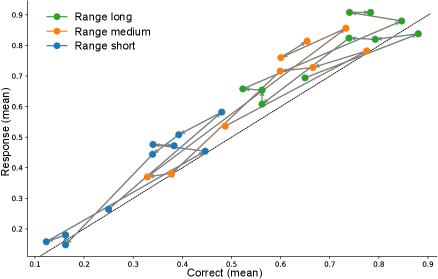
摘要: Large language models (LLMs) excel at explicit reasoning, but their implicit computational strategies remain underexplored. Decades of psychophysics research show that humans intuitively process and integrate noisy signals using near-optimal Bayesian strategies in perceptual tasks. We ask whether LLMs exhibit similar behaviour and perform optimal multimodal integration without explicit training or instruction. Adopting the psychophysics paradigm, we infer computational principles of LLMs from systematic behavioural studies. We introduce a behavioural benchmark - BayesBench: four magnitude estimation tasks (length, location, distance, and duration) over text and image, inspired by classic psychophysics, and evaluate a diverse set of nine LLMs alongside human judgments for calibration. Through controlled ablations of noise, context, and instruction prompts, we measure performance, behaviour and efficiency in multimodal cue-combination. Beyond accuracy and efficiency metrics, we introduce a Bayesian Consistency Score that detects Bayes-consistent behavioural shifts even when accuracy saturates. Our results show that while capable models often adapt in Bayes-consistent ways, accuracy does not guarantee robustness. Notably, GPT-5 Mini achieves perfect text accuracy but fails to integrate visual cues efficiently. This reveals a critical dissociation between capability and strategy, suggesting accuracy-centric benchmarks may over-index on performance while missing brittle uncertainty handling. These findings reveal emergent principled handling of uncertainty and highlight the correlation between accuracy and Bayesian tendencies. We release our psychophysics benchmark and consistency metric as evaluation tools and to inform future multimodal architecture designs111Project webpage: https://bayes-bench.github.io.