
Paper List
-
Discovery of a Hematopoietic Manifold in scGPT Yields a Method for Extracting Performant Algorithms from Biological Foundation Model Internals
This work addresses the core challenge of extracting reusable, interpretable, and high-performance biological algorithms from the opaque internal repr...
-
MS2MetGAN: Latent-space adversarial training for metabolite–spectrum matching in MS/MS database search
This paper addresses the critical bottleneck in metabolite identification: the generation of high-quality negative training samples that are structura...
-
Toward Robust, Reproducible, and Widely Accessible Intracranial Language Brain-Computer Interfaces: A Comprehensive Review of Neural Mechanisms, Hardware, Algorithms, Evaluation, Clinical Pathways and Future Directions
This review addresses the core challenge of fragmented and heterogeneous evidence that hinders the clinical translation of intracranial language BCIs,...
-
Less Is More in Chemotherapy of Breast Cancer
通过纳入细胞周期时滞和竞争项,解决了现有肿瘤-免疫模型的过度简化问题,以定量比较化疗方案。
-
Fold-CP: A Context Parallelism Framework for Biomolecular Modeling
This paper addresses the critical bottleneck of GPU memory limitations that restrict AlphaFold 3-like models to processing only a few thousand residue...
-
Open Biomedical Knowledge Graphs at Scale: Construction, Federation, and AI Agent Access with Samyama Graph Database
This paper addresses the core pain point of fragmented biomedical data by constructing and federating large-scale, open knowledge graphs to enable sea...
-
Predictive Analytics for Foot Ulcers Using Time-Series Temperature and Pressure Data
This paper addresses the critical need for continuous, real-time monitoring of diabetic foot health by developing an unsupervised anomaly detection fr...
-
Hypothesis-Based Particle Detection for Accurate Nanoparticle Counting and Digital Diagnostics
This paper addresses the core challenge of achieving accurate, interpretable, and training-free nanoparticle counting in digital diagnostic assays, wh...
Fluctuating Environments Favor Extreme Dormancy Strategies and Penalize Intermediate Ones
Universidad de Córdoba, Spain | Istituto Nazionale di Oceanografia e Geofisica Sperimentale (OGS), Italy | Universidad de Granada, Spain


30秒速读
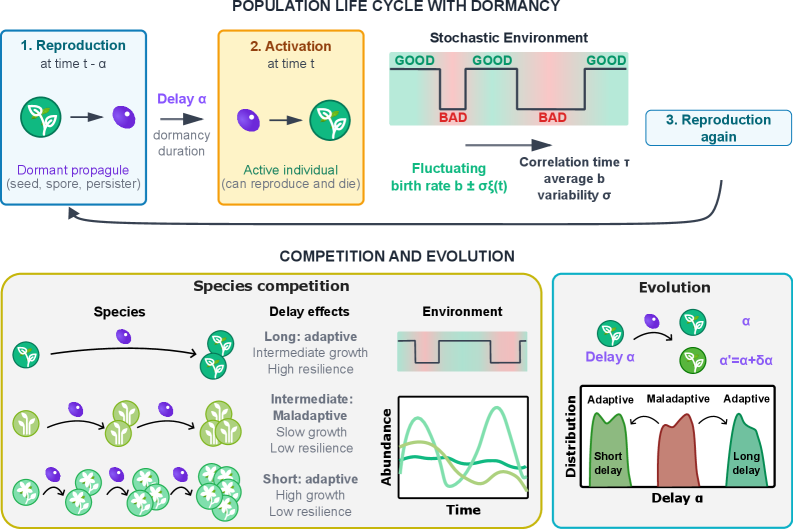
IN SHORT: This paper addresses the core challenge of determining how organisms should tune dormancy duration to match the temporal autocorrelation of their environment, revealing that intermediate dormancy times are systematically maladaptive.
核心创新
- Theory Identifies a generic mechanism where the interplay between demographic delay (dormancy) and environmental autocorrelation generates a strongly non-monotonic fitness landscape.
- Methodology Develops a parsimonious delayed-logistic model with colored multiplicative noise (dichotomous Markov noise) to analytically and numerically dissect the three-regime population performance.
- Biology Demonstrates evolutionary bistability, where selection favors either very short or very long dormancy strategies, systematically avoiding the maladaptive intermediate regime, as confirmed by an agent-based model.
主要结论
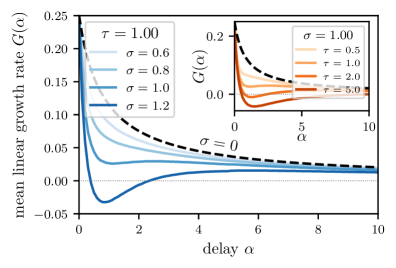
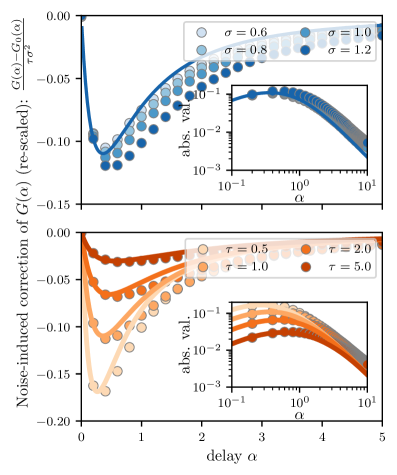
- For a population near the critical threshold (b ≳ d), the mean linear growth rate G(α) exhibits a local minimum at intermediate dormancy durations when noise amplitude σ or correlation time τ exceed a threshold, making this strategy globally least favorable (Figure 4).
- The stationary mean population density x* shows a pronounced depression (a 'valley') for intermediate α combined with strong environmental noise (σ > 0), which deepens and broadens as σ increases, potentially driving extinction (Figure 3).
- Evolutionary simulations confirm bistable selection: populations evolve towards either very short (α → 0) or very long (α ≳ 5) dormancy extremes, with the intermediate regime (e.g., α = 1) consistently leading to population collapse.
摘要: Dormancy is a widespread adaptive strategy that enables biological populations to persist in fluctuating environments. Yet how its evolutionary benefits depend on the temporal structure of environmental variability, and whether dormancy can become systematically maladaptive, remains poorly understood. Here we examine how dormancy interacts with environmental correlation times using a parsimonious delayed-logistic model in which dormant individuals reactivate after a fixed lag while birth rates fluctuate under temporally correlated stochasticity. Numerical simulations and analytical calculations reveal that the joint effect of demographic memory and colored multiplicative noise generates a strongly non-monotonic dependence of fitness on dormancy duration, with three distinct regimes of population performance. Very short dormancy maximizes linear growth but amplifies fluctuations and extinction risk. Very long dormancy buffers environmental variability, substantially increasing mean extinction times despite slower growth. Strikingly, and central to our results, there is a broad band of intermediate dormancy durations that is maladaptive, simultaneously reducing both growth and persistence—an effect that arises generically from the mismatch between delay times and environmental autocorrelation. The predicted bistability between short- and long-dormancy strategies is confirmed in an evolutionary agent-based model, which avoids intermediate lag times and selects for evolutionarily stable extremes. Our results show that dormancy duration is not merely a life-history parameter but an adaptive mechanism tuned to environmental timescales, and that “dangerous middle” dormancy times can be inherently disfavored, with implications for understanding persistence in seed banks, microbial persisters, and cancer cell dormancy. More broadly, this work identifies a general mechanism by which demographic delays interacting with correlated environmental variability generate a non-monotonic fitness landscape that selects for extreme timing strategies, and raises fundamental questions on analyzing delayed, non-Markovian dynamics driven by correlated multiplicative noise near absorbing boundaries.