
Paper List
-
Evolutionarily Stable Stackelberg Equilibrium
通过要求追随者策略对突变入侵具有鲁棒性,弥合了斯塔克尔伯格领导力模型与演化稳定性之间的鸿沟。
-
Recovering Sparse Neural Connectivity from Partial Measurements: A Covariance-Based Approach with Granger-Causality Refinement
通过跨多个实验会话累积协方差统计,实现从部分记录到完整神经连接性的重建。
-
Atomic Trajectory Modeling with State Space Models for Biomolecular Dynamics
ATMOS通过提供一个基于SSM的高效框架,用于生物分子的原子级轨迹生成,弥合了计算昂贵的MD模拟与时间受限的深度生成模型之间的差距。
-
Slow evolution towards generalism in a model of variable dietary range
通过证明是种群统计噪声(而非确定性动力学)驱动了模式形成和泛化食性的演化,解决了间接竞争下物种形成的悖论。
-
Grounded Multimodal Retrieval-Augmented Drafting of Radiology Impressions Using Case-Based Similarity Search
通过将印象草稿基于检索到的历史病例,并采用明确引用和基于置信度的拒绝机制,解决放射学报告生成中的幻觉问题。
-
Unified Policy–Value Decomposition for Rapid Adaptation
通过双线性分解在策略和价值函数之间共享低维目标嵌入,实现对新颖任务的零样本适应。
-
Mathematical Modeling of Cancer–Bacterial Therapy: Analysis and Numerical Simulation via Physics-Informed Neural Networks
提供了一个严格的、无网格的PINN框架,用于模拟和分析细菌癌症疗法中复杂的、空间异质的相互作用。
-
Sample-Efficient Adaptation of Drug-Response Models to Patient Tumors under Strong Biological Domain Shift
通过从无标记分子谱中学习可迁移表征,利用最少的临床数据实现患者药物反应的有效预测。
Fluctuating Environments Favor Extreme Dormancy Strategies and Penalize Intermediate Ones
Universidad de Córdoba, Spain | Istituto Nazionale di Oceanografia e Geofisica Sperimentale (OGS), Italy | Universidad de Granada, Spain


30秒速读
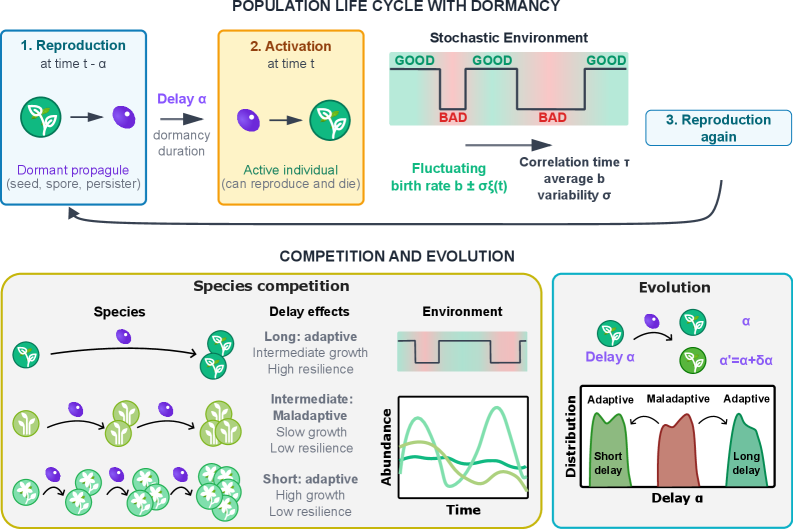
IN SHORT: This paper addresses the core challenge of determining how organisms should tune dormancy duration to match the temporal autocorrelation of their environment, revealing that intermediate dormancy times are systematically maladaptive.
核心创新
- Theory Identifies a generic mechanism where the interplay between demographic delay (dormancy) and environmental autocorrelation generates a strongly non-monotonic fitness landscape.
- Methodology Develops a parsimonious delayed-logistic model with colored multiplicative noise (dichotomous Markov noise) to analytically and numerically dissect the three-regime population performance.
- Biology Demonstrates evolutionary bistability, where selection favors either very short or very long dormancy strategies, systematically avoiding the maladaptive intermediate regime, as confirmed by an agent-based model.
主要结论
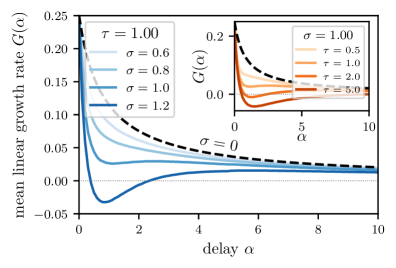
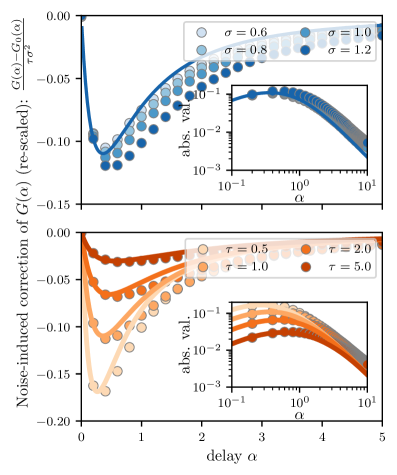
- For a population near the critical threshold (b ≳ d), the mean linear growth rate G(α) exhibits a local minimum at intermediate dormancy durations when noise amplitude σ or correlation time τ exceed a threshold, making this strategy globally least favorable (Figure 4).
- The stationary mean population density x* shows a pronounced depression (a 'valley') for intermediate α combined with strong environmental noise (σ > 0), which deepens and broadens as σ increases, potentially driving extinction (Figure 3).
- Evolutionary simulations confirm bistable selection: populations evolve towards either very short (α → 0) or very long (α ≳ 5) dormancy extremes, with the intermediate regime (e.g., α = 1) consistently leading to population collapse.
摘要: Dormancy is a widespread adaptive strategy that enables biological populations to persist in fluctuating environments. Yet how its evolutionary benefits depend on the temporal structure of environmental variability, and whether dormancy can become systematically maladaptive, remains poorly understood. Here we examine how dormancy interacts with environmental correlation times using a parsimonious delayed-logistic model in which dormant individuals reactivate after a fixed lag while birth rates fluctuate under temporally correlated stochasticity. Numerical simulations and analytical calculations reveal that the joint effect of demographic memory and colored multiplicative noise generates a strongly non-monotonic dependence of fitness on dormancy duration, with three distinct regimes of population performance. Very short dormancy maximizes linear growth but amplifies fluctuations and extinction risk. Very long dormancy buffers environmental variability, substantially increasing mean extinction times despite slower growth. Strikingly, and central to our results, there is a broad band of intermediate dormancy durations that is maladaptive, simultaneously reducing both growth and persistence—an effect that arises generically from the mismatch between delay times and environmental autocorrelation. The predicted bistability between short- and long-dormancy strategies is confirmed in an evolutionary agent-based model, which avoids intermediate lag times and selects for evolutionarily stable extremes. Our results show that dormancy duration is not merely a life-history parameter but an adaptive mechanism tuned to environmental timescales, and that “dangerous middle” dormancy times can be inherently disfavored, with implications for understanding persistence in seed banks, microbial persisters, and cancer cell dormancy. More broadly, this work identifies a general mechanism by which demographic delays interacting with correlated environmental variability generate a non-monotonic fitness landscape that selects for extreme timing strategies, and raises fundamental questions on analyzing delayed, non-Markovian dynamics driven by correlated multiplicative noise near absorbing boundaries.