
Paper List
-
Formation of Artificial Neural Assemblies by Biologically Plausible Inhibition Mechanisms
This work addresses the core limitation of the Assembly Calculus model—its fixed-size, biologically implausible k-WTA selection process—by introducing...
-
How to make the most of your masked language model for protein engineering
This paper addresses the critical bottleneck of efficiently sampling high-quality, diverse protein sequences from Masked Language Models (MLMs) for pr...
-
Module control in youth symptom networks across COVID-19
This paper addresses the core challenge of distinguishing whether a prolonged societal stressor (COVID-19) fundamentally reorganizes the architecture ...
-
JEDI: Jointly Embedded Inference of Neural Dynamics
This paper addresses the core challenge of inferring context-dependent neural dynamics from noisy, high-dimensional recordings using a single unified ...
-
ATP Level and Phosphorylation Free Energy Regulate Trigger-Wave Speed and Critical Nucleus Size in Cellular Biochemical Systems
This work addresses the core challenge of quantitatively predicting how the cellular energy state (ATP level and phosphorylation free energy) governs ...
-
Packaging Jupyter notebooks as installable desktop apps using LabConstrictor
This paper addresses the core pain point of ensuring Jupyter notebook reproducibility and accessibility across different computing environments, parti...
-
SNPgen: Phenotype-Supervised Genotype Representation and Synthetic Data Generation via Latent Diffusion
This paper addresses the core challenge of generating privacy-preserving synthetic genotype data that maintains both statistical fidelity and downstre...
-
Continuous Diffusion Transformers for Designing Synthetic Regulatory Elements
This paper addresses the challenge of efficiently generating novel, cell-type-specific regulatory DNA sequences with high predicted activity while min...
DeeDeeExperiment: Building an infrastructure for integrating and managing omics data analysis results in R/Bioconductor
Institute of Medical Biostatistics, Epidemiology and Informatics (IMBEI), University Medical Center Mainz | Research Center for Immunotherapy (FZI) Mainz | Department of Nephrology, Rheumatology and Kidney Transplantation, University Medical Center Mainz
30秒速读
IN SHORT: This paper addresses the critical bottleneck of managing and organizing the growing volume of differential expression and functional enrichment analysis results from complex omics experiments, which currently lack standardized data structures for storage and contextualization.
核心创新
- Methodology Introduces the first standardized S4 class specifically designed to co-store DEA and FEA results with their metadata in a single, structured container within the Bioconductor ecosystem.
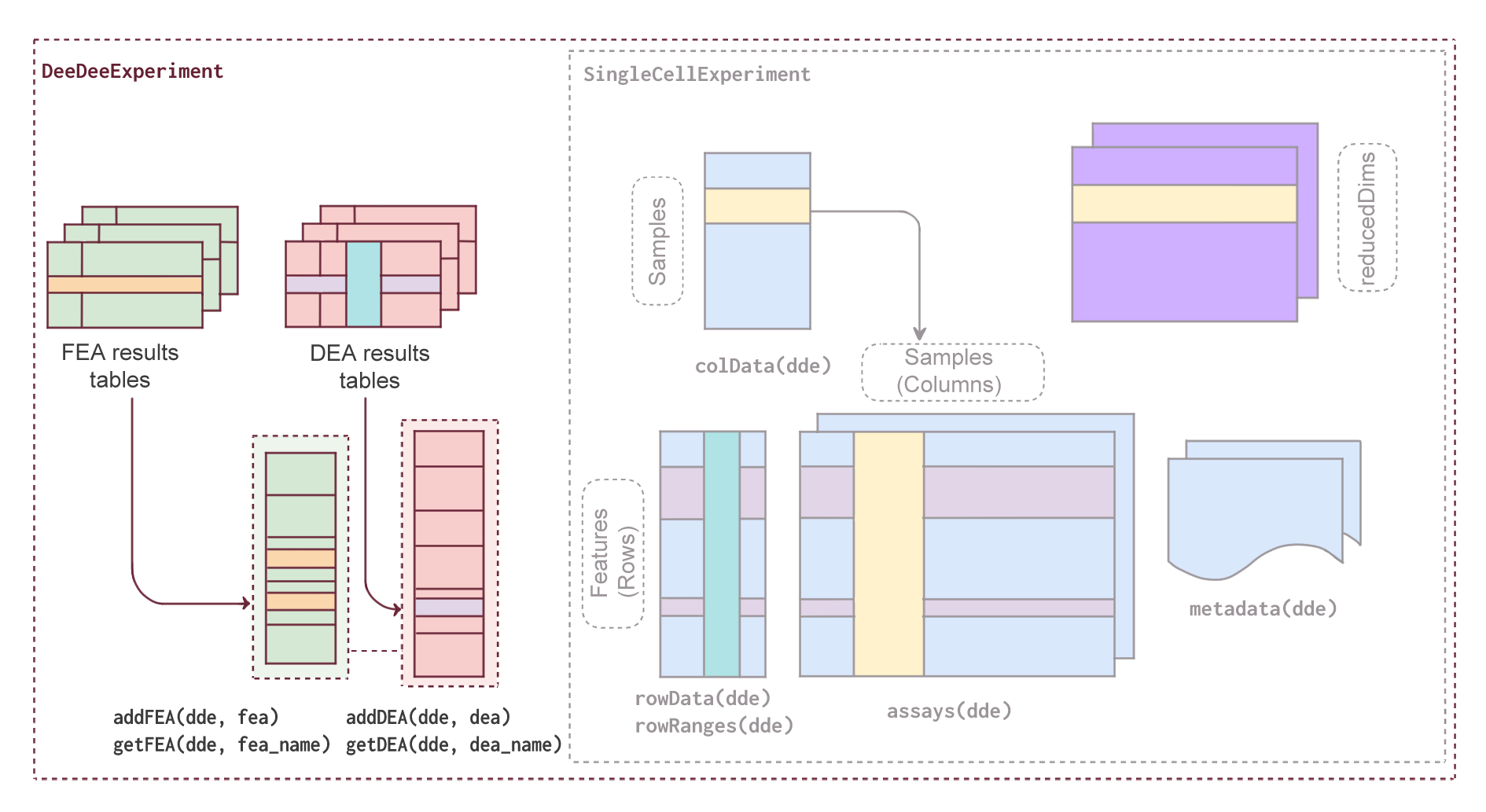
- Methodology Extends the widely adopted SingleCellExperiment class by adding dedicated slots for DEA and FEA results while maintaining full backward compatibility with existing Bioconductor tools.
- Methodology Implements a contrast-centric architecture that organizes results from multiple comparisons (including limma multi-contrast objects and muscat pseudobulk analyses) with efficient storage through pointer-based referencing.
主要结论
- DeeDeeExperiment provides a robust, standardized framework that enables efficient organization and retrieval of DEA/FEA results across multiple contrasts within a single data object.
- The implementation maintains full compatibility with the Bioconductor ecosystem, supporting interoperability with downstream tools like scater for visualization and iSEE for interactive exploration.
- By consolidating analysis results and metadata, the framework supports more nuanced quantitative approaches beyond simple overlap strategies, enabling trustworthy summaries of complex experimental measurements.
摘要: Summary: Modern omics experiments now involve multiple conditions and complex designs, producing an increasingly large set of differential expression and functional enrichment analysis results. However, no standardized data structure exists to store and contextualize these results together with their metadata, leaving researchers with an unmanageable and potentially non-reproducible collection of results that are difficult to navigate and/or share. Here we introduce DeeDeeExperiment, a new S4 class for managing and storing omics data analysis results, implemented within the Bioconductor ecosystem, which promotes interoperability, reproducibility and good documentation. This class extends the widely used SingleCellExperiment object by introducing dedicated slots for Differential Expression (DEA) and Functional Enrichment Analysis (FEA) results, allowing users to organize, store, and retrieve information on multiple contrasts and associated metadata within a single data object, ultimately streamlining the management and interpretation of many omics datasets. Availability and implementation: DeeDeeExperiment is available on Bioconductor under the MIT license (https://bioconductor.org/packages/DeeDeeExperiment), with its development version also available on Github (https://github.com/imbeimainz/DeeDeeExperiment).