
Paper List
-
Autonomous Agents Coordinating Distributed Discovery Through Emergent Artifact Exchange
This paper addresses the fundamental limitation of current AI-assisted scientific research by enabling truly autonomous, decentralized investigation w...
-
D-MEM: Dopamine-Gated Agentic Memory via Reward Prediction Error Routing
This paper addresses the fundamental scalability bottleneck in LLM agentic memory systems: the O(N²) computational complexity and unbounded API token ...
-
Countershading coloration in blue shark skin emerges from hierarchically organized and spatially tuned photonic architectures inside skin denticles
This paper solves the core problem of how blue sharks achieve their striking dorsoventral countershading camouflage, revealing that coloration origina...
-
Human-like Object Grouping in Self-supervised Vision Transformers
This paper addresses the core challenge of quantifying how well self-supervised vision models capture human-like object grouping in natural scenes, br...
-
Hierarchical pp-Adic Framework for Gene Regulatory Networks: Theory and Stability Analysis
This paper addresses the core challenge of mathematically capturing the inherent hierarchical organization and multi-scale stability of gene regulator...
-
Towards unified brain-to-text decoding across speech production and perception
This paper addresses the core challenge of developing a unified brain-to-text decoding framework that works across both speech production and percepti...
-
Dual-Laws Model for a theory of artificial consciousness
This paper addresses the core challenge of developing a comprehensive, testable theory of consciousness that bridges biological and artificial systems...
-
Pulse desynchronization of neural populations by targeting the centroid of the limit cycle in phase space
This work addresses the core challenge of determining optimal pulse timing and intensity for desynchronizing pathological neural oscillations when the...
MCP-AI: Protocol-Driven Intelligence Framework for Autonomous Reasoning in Healthcare
Organizations not explicitly listed in provided content
30秒速读
IN SHORT: This paper addresses the critical gap in healthcare AI systems that lack contextual reasoning, long-term state management, and verifiable workflows by introducing a protocol-driven framework that enables autonomous, explainable clinical decision-making.
核心创新
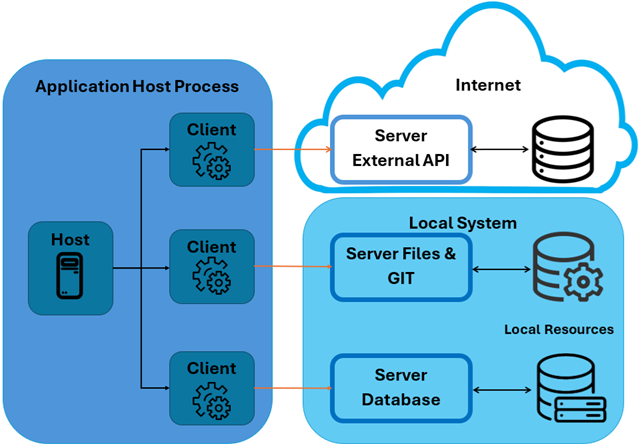
- Methodology Introduces the Model Context Protocol (MCP) as a structured, version-controlled file format that captures patient state, clinical objectives, and reasoning history, creating reusable and auditable memory objects.
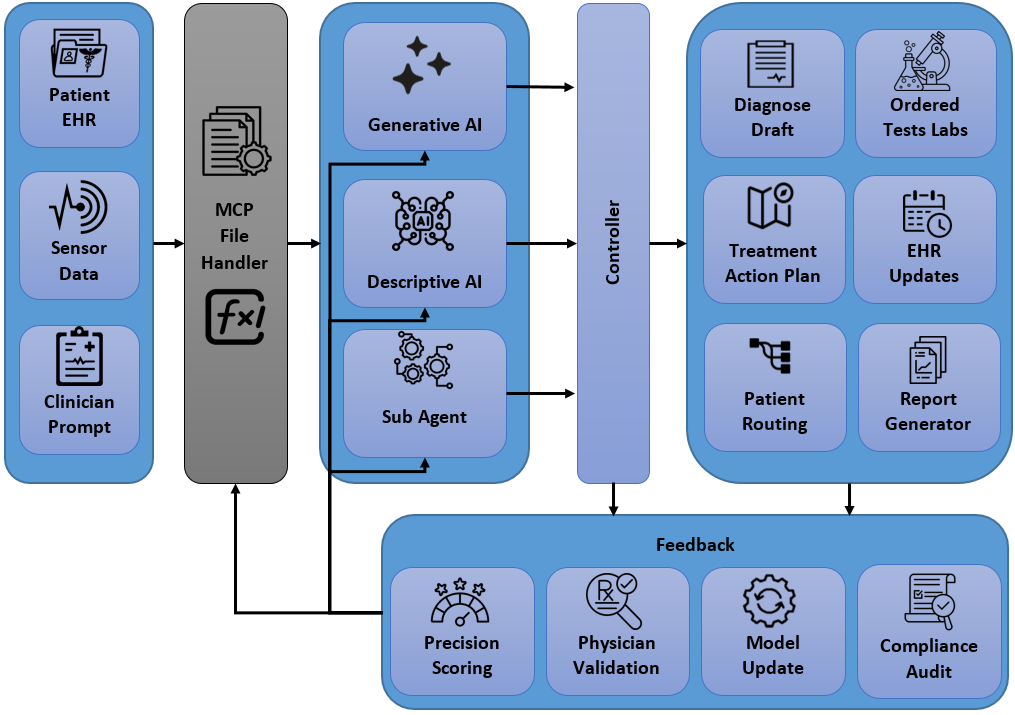
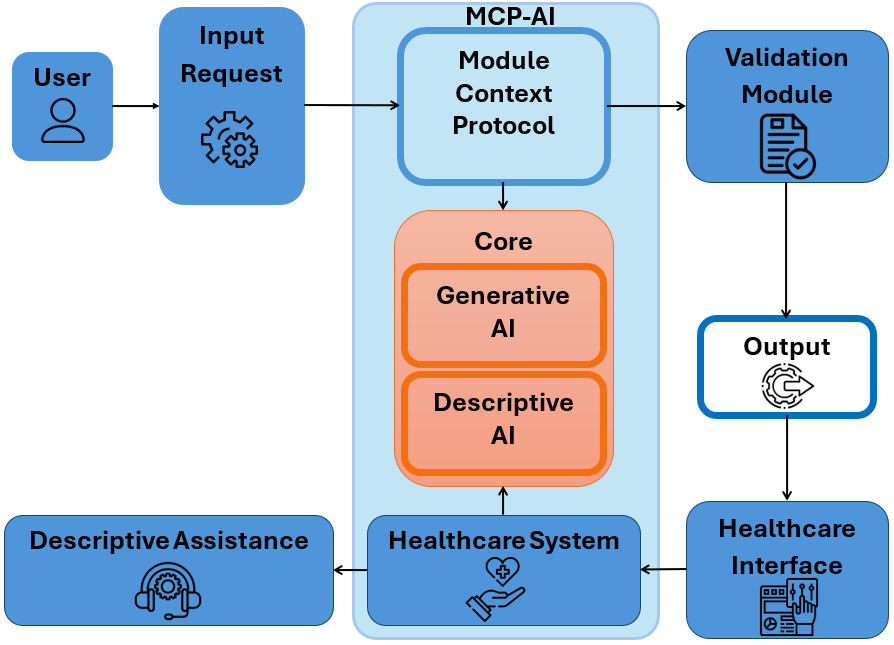
- Methodology Develops a hybrid architecture combining generative AI (for narrative diagnosis and planning) with descriptive AI (for rule validation and scoring) within a persistent reasoning context.
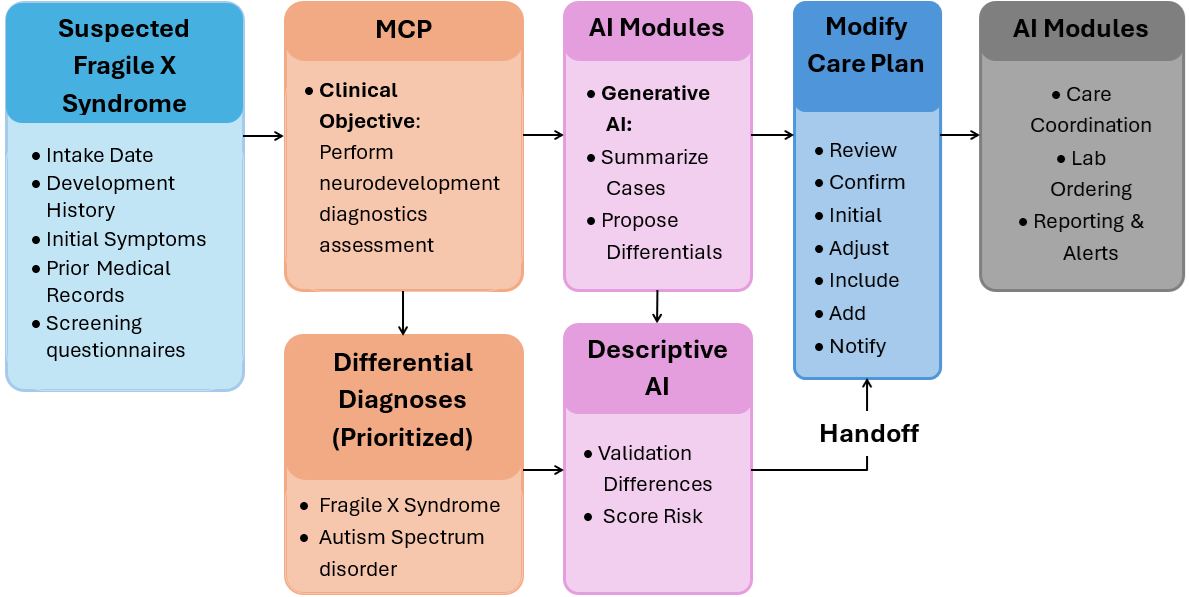
- Biology Demonstrates clinical utility through two complex use cases: Fragile X Syndrome with comorbid depression (rare neurodevelopmental disorder) and Type 2 Diabetes with hypertension (chronic care coordination).
主要结论
- MCP-AI enables adaptive, longitudinal reasoning across care settings, demonstrated through successful simulation of complex diagnostic pathways for Fragile X Syndrome with comorbid depression.
- The framework supports secure transitions of AI responsibilities between healthcare providers while maintaining clinical context, validated in chronic disease coordination scenarios for diabetes and hypertension.
- MCP-AI provides traceable, auditable decision-making with built-in physician verification, aligning with regulatory standards including HIPAA and FDA SaMD guidelines for clinical deployment.
摘要: Healthcare AI systems have historically faced challenges in merging contextual reasoning, long-term state management, and human-verifiable workflows into a cohesive framework. This paper introduces a completely innovative architecture and concept: combining the Model Context Protocol (MCP) with a specific clinical application, known as MCP-AI. This integration allows intelligent agents to reason over extended periods, collaborate securely, and adhere to authentic clinical logic, representing a significant shift away from traditional Clinical Decision Support Systems (CDSS) and prompt-based Large Language Models (LLMs). As healthcare systems become more complex, the need for autonomous, context-aware clinical reasoning frameworks has become urgent. We present MCP-AI, a novel architecture for explainable medical decision-making built upon the Model Context Protocol (MCP) a modular, executable specification for orchestrating generative and descriptive AI agents in real-time workflows. Each MCP file captures clinical objectives, patient context, reasoning state, and task logic, forming a reusable and auditable memory object. Unlike conventional CDSS or stateless prompt-based AI systems, MCP-AI supports adaptive, longitudinal, and collaborative reasoning across care settings. MCP-AI is validated through two use cases: (1) diagnostic modeling of Fragile X Syndrome with comorbid depression, and (2) remote coordination for Type 2 Diabetes and hypertension. In either scenario, the protocol facilitates physician-in-the-loop validation, streamlines clinical processes, and guarantees secure transitions of AI responsibilities between healthcare providers. The system connects with HL7/FHIR interfaces and adheres to regulatory standards, such as HIPAA and FDA SaMD guidelines. MCP-AI provides a scalable basis for interpretable, composable, and safety-oriented AI within upcoming clinical environments.