
Paper List
-
Autonomous Agents Coordinating Distributed Discovery Through Emergent Artifact Exchange
This paper addresses the fundamental limitation of current AI-assisted scientific research by enabling truly autonomous, decentralized investigation w...
-
D-MEM: Dopamine-Gated Agentic Memory via Reward Prediction Error Routing
This paper addresses the fundamental scalability bottleneck in LLM agentic memory systems: the O(N²) computational complexity and unbounded API token ...
-
Countershading coloration in blue shark skin emerges from hierarchically organized and spatially tuned photonic architectures inside skin denticles
This paper solves the core problem of how blue sharks achieve their striking dorsoventral countershading camouflage, revealing that coloration origina...
-
Human-like Object Grouping in Self-supervised Vision Transformers
This paper addresses the core challenge of quantifying how well self-supervised vision models capture human-like object grouping in natural scenes, br...
-
Hierarchical pp-Adic Framework for Gene Regulatory Networks: Theory and Stability Analysis
This paper addresses the core challenge of mathematically capturing the inherent hierarchical organization and multi-scale stability of gene regulator...
-
Towards unified brain-to-text decoding across speech production and perception
This paper addresses the core challenge of developing a unified brain-to-text decoding framework that works across both speech production and percepti...
-
Dual-Laws Model for a theory of artificial consciousness
This paper addresses the core challenge of developing a comprehensive, testable theory of consciousness that bridges biological and artificial systems...
-
Pulse desynchronization of neural populations by targeting the centroid of the limit cycle in phase space
This work addresses the core challenge of determining optimal pulse timing and intensity for desynchronizing pathological neural oscillations when the...
pHapCompass: Probabilistic Assembly and Uncertainty Quantification of Polyploid Haplotype Phase
School of Computing, University of Connecticut | Department of Entomology and Plant Pathology, University of Tennessee | Institute for Systems Genomics, University of Connecticut
30秒速读
IN SHORT: This paper addresses the core challenge of accurately assembling polyploid haplotypes from sequencing data, where read assignment ambiguity and an exponential search space of possible phasings have hindered reliable reconstruction and uncertainty quantification.
核心创新
- Methodology Introduces pHapCompass, the first probabilistic haplotype assembler for diploid and polyploid genomes that explicitly models read assignment ambiguity to compute a distribution over haplotype phasings, enabling formal uncertainty quantification.
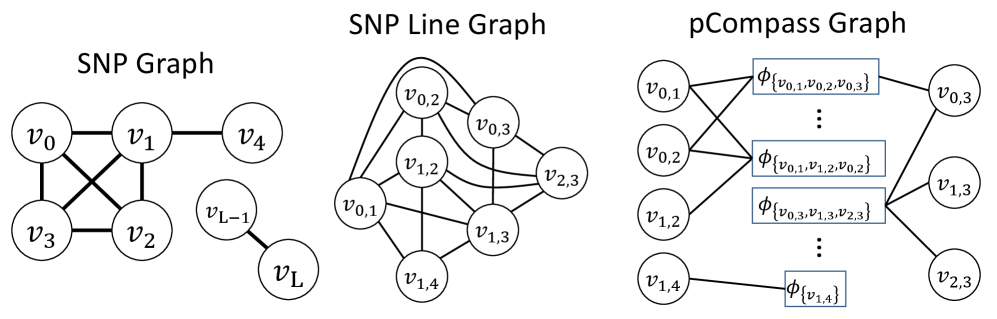
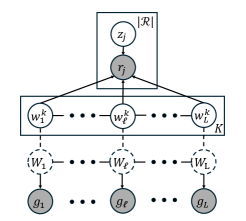
- Methodology Develops two distinct graph-theoretic algorithms: pHapCompass-short (a Markov random field for high-coverage short reads) and pHapCompass-long (a hierarchical mixture model for low-coverage long reads), both designed to scale with genomic complexity.
- Methodology Creates the first computational workflow for simulating realistic auto- and allopolyploid genomes and sequencing data, addressing a critical gap in benchmarking tools that previously relied on oversimplified synthetic genomes.
主要结论
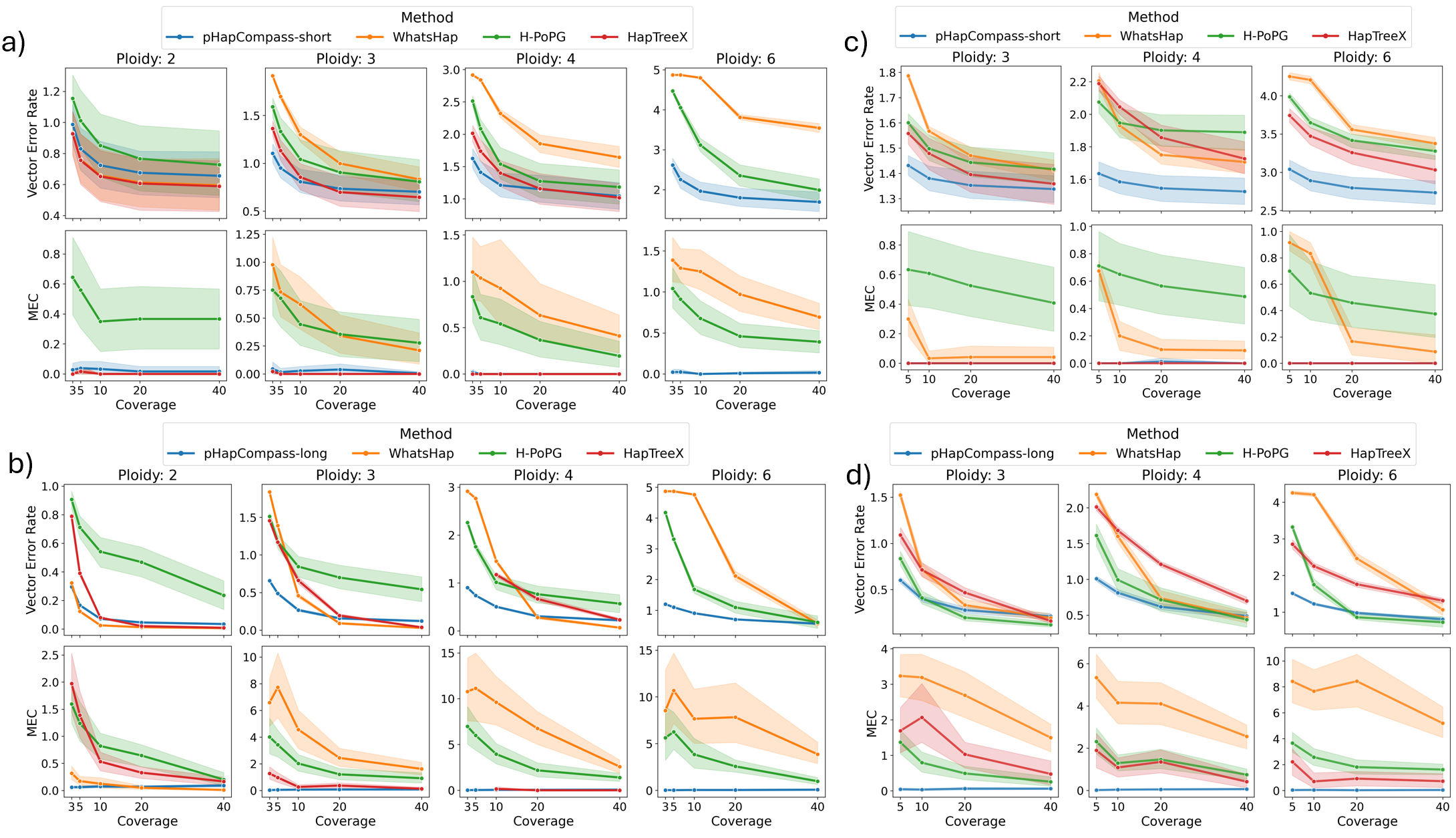
- pHapCompass demonstrates competitive performance against existing assemblers across varying ploidy levels, coverage depths, and mutation rates, while uniquely providing accurate quantification of phase uncertainty.
- The developed simulation workflow generates more realistic benchmarking datasets, revealing that prior methods often overestimate performance on simplistic synthetic genomes.
- The framework successfully assembled an allo-octoploid strawberry chromosome, showcasing practical applicability to complex, real-world polyploid genomes.
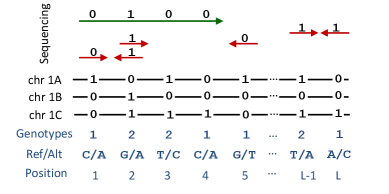
摘要: Computing haplotypes from sequencing data, i.e. haplotype assembly, is an important component of foundational molecular and population genetics problems, including interpreting the effects of genetic variation on complex traits and reconstructing genealogical relationships. Assembling the haplotypes of polyploid genomes remains a significant challenge due to the exponential search space of haplotype phasings and read assignment ambiguity; the latter challenge is particularly difficult for polyploid haplotype assemblers since the information contained within the observed sequence reads is often insufficient for unambiguous haplotype assignment in polyploid genomes. We present pHapCompass, probabilistic haplotype assembly algorithms for diploid and polyploid genomes that explicitly model and propagate read assignment ambiguity to compute a distribution over polyploid haplotype phasings. We develop graph theoretic algorithms to enable statistical inference and uncertainty quantification despite an exponential space of possible phasings. Since prior work evaluates polyploid haplotype assembly on synthetic genomes that do not reflect the realistic genomic complexity of polyploidy organisms, we develop a computational workflow for simulating genomes and DNA-seq for auto- and allopolyploids. Additionally, we generalize the vector error rate and minimum error correction evaluation criteria for partially phased haplotypes. Benchmarking of pHapCompass and several existing polyploid haplotype assemblers shows that pHapCompass yields competitive performance across varying genomic complexities and polyploid structures while retaining an accurate quantification of phase uncertainty. The source code for pHapCompass, simulation scripts, and datasets are freely available at https://github.com/bayesomicslab/pHapCompass.