
Paper List
-
Discovery of a Hematopoietic Manifold in scGPT Yields a Method for Extracting Performant Algorithms from Biological Foundation Model Internals
This work addresses the core challenge of extracting reusable, interpretable, and high-performance biological algorithms from the opaque internal repr...
-
MS2MetGAN: Latent-space adversarial training for metabolite–spectrum matching in MS/MS database search
This paper addresses the critical bottleneck in metabolite identification: the generation of high-quality negative training samples that are structura...
-
Toward Robust, Reproducible, and Widely Accessible Intracranial Language Brain-Computer Interfaces: A Comprehensive Review of Neural Mechanisms, Hardware, Algorithms, Evaluation, Clinical Pathways and Future Directions
This review addresses the core challenge of fragmented and heterogeneous evidence that hinders the clinical translation of intracranial language BCIs,...
-
Less Is More in Chemotherapy of Breast Cancer
通过纳入细胞周期时滞和竞争项,解决了现有肿瘤-免疫模型的过度简化问题,以定量比较化疗方案。
-
Fold-CP: A Context Parallelism Framework for Biomolecular Modeling
This paper addresses the critical bottleneck of GPU memory limitations that restrict AlphaFold 3-like models to processing only a few thousand residue...
-
Open Biomedical Knowledge Graphs at Scale: Construction, Federation, and AI Agent Access with Samyama Graph Database
This paper addresses the core pain point of fragmented biomedical data by constructing and federating large-scale, open knowledge graphs to enable sea...
-
Predictive Analytics for Foot Ulcers Using Time-Series Temperature and Pressure Data
This paper addresses the critical need for continuous, real-time monitoring of diabetic foot health by developing an unsupervised anomaly detection fr...
-
Hypothesis-Based Particle Detection for Accurate Nanoparticle Counting and Digital Diagnostics
This paper addresses the core challenge of achieving accurate, interpretable, and training-free nanoparticle counting in digital diagnostic assays, wh...
Collective adsorption of pheromones at the water-air interface
Aix Marseille Univ, CNRS, Centrale Med, IRPHE (UMR 7342), Marseille, France | ICSM, CEA, CNRS, ENSCM, Univ. Montpellier, Marcoule, France | Institut de Recherche sur la Biologie de l’Insecte, UMR 7261, CNRS-Université de Tours, Tours, France


30秒速读
IN SHORT: This paper addresses the core challenge of understanding how amphiphilic pheromones, previously assumed to be transported in the gas phase, can be stabilized and concentrated at the water-air interface of atmospheric aerosols through collective adsorption and a 2D phase transition.
核心创新
- Methodology Presents state-of-the-art all-atom molecular dynamics simulations to construct a full Langmuir adsorption isotherm for a pheromone monolayer, a comprehensive approach rare in the field.
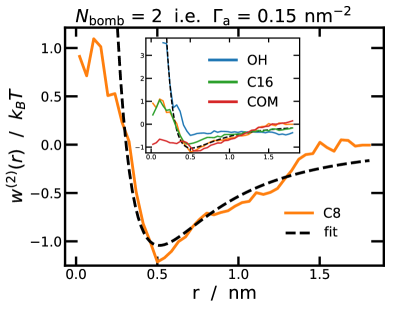
- Biology Quantifies the collective adsorption free energy gain (~2kBT per molecule) for bombykol at the water-air interface, providing a mechanistic explanation for pheromone enrichment on atmospheric aerosols.
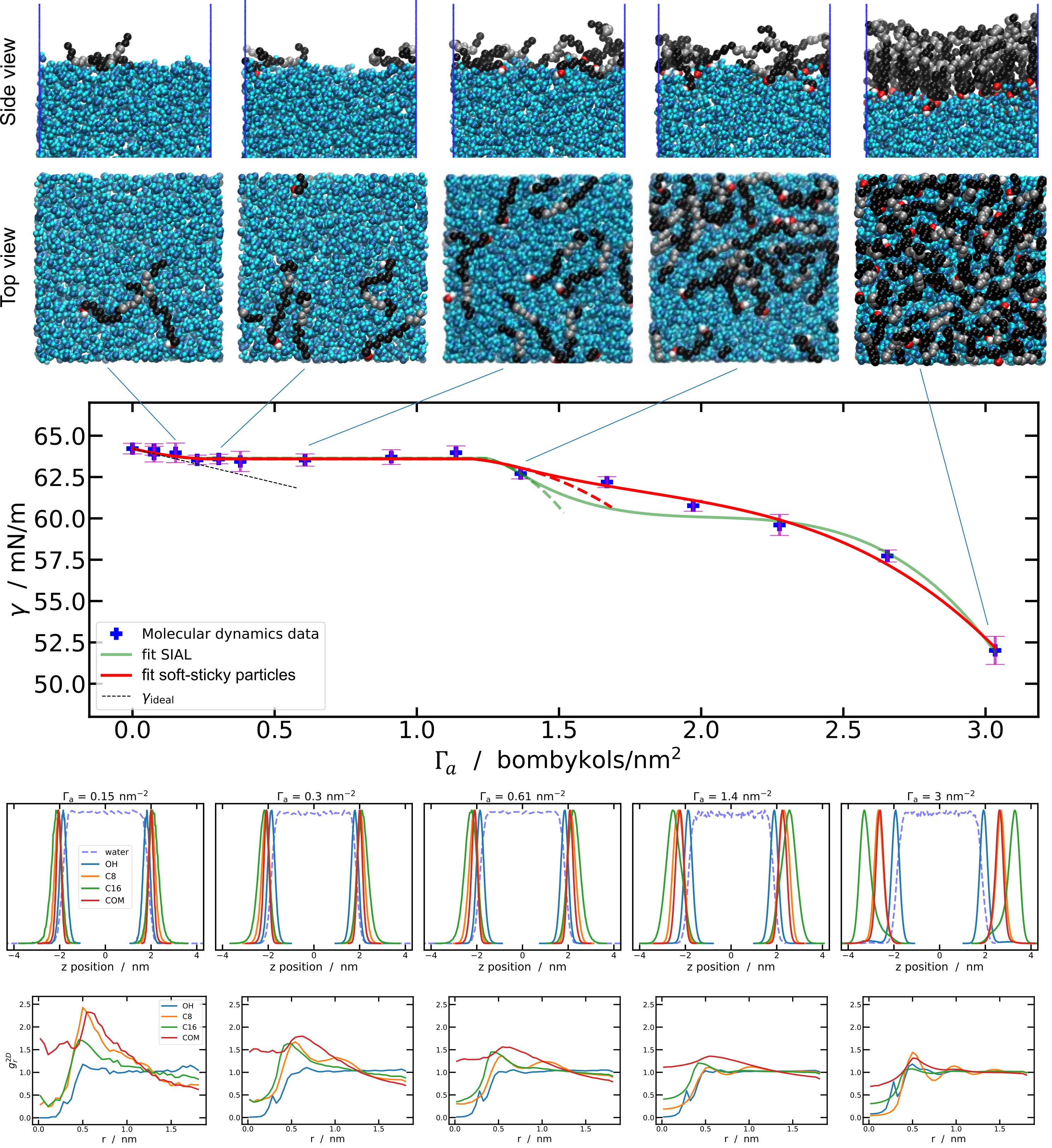
- Theory Identifies and characterizes a two-dimensional liquid-gas phase transition within the pheromone monolayer, modeled successfully with a soft-sticky particle equation of state.
主要结论
- Collective interactions within a bombykol monolayer at the water-air interface provide a stabilization free energy of approximately 2kBT per molecule, significantly enhancing adsorption compared to individual molecules.
- The monolayer exhibits a clear two-dimensional liquid-gas phase transition, accurately described by a soft-sticky particle equation of state, with the transition plateau evident in the surface tension vs. concentration isotherm.
- The calculated adsorption free energy increases under lower estimates of the condensing surface concentration (ΓC), indicating that pheromone adsorption onto aerosols is more favorable in dilute regimes, relevant for atmospheric conditions.
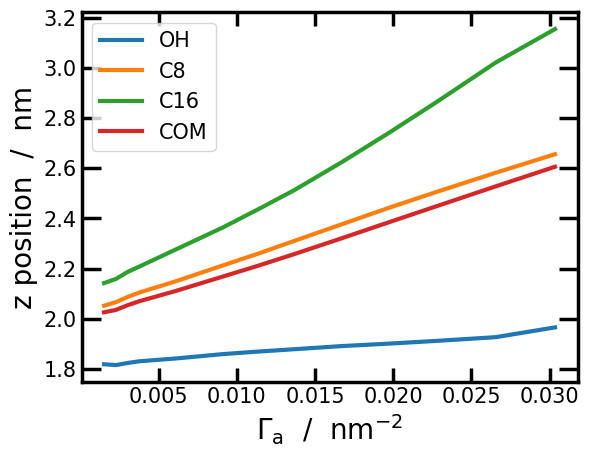
摘要: Understanding the phase behaviour of pheromones and other messaging molecules remains a significant and largely unexplored challenge, even though it plays a central role in chemical communication. Here, we present all-atom molecular dynamics simulations to investigate the behavior of bombykol, a model insect pheromone, adsorbed at the water–air interface. This system serves as a proxy for studying the amphiphilic nature of pheromones and their interactions with aerosol particles in the atmosphere. Our simulations reveal the molecular organization of the bombykol monolayer and its adsorption isotherm. A soft-sticky particle equation of state accurately describes the monolayer’s behavior. The analysis uncovers a two-dimensional liquid–gas phase transition within the monolayer. Collective adsorption stabilises the molecules at the interface and the calculated free energy gain is approximately 2kBT. This value increases under lower estimates of the condensing surface concentration, thereby enhancing pheromone adsorption onto aerosols. Overall, our findings hold broad relevance for molecular interface science, atmospheric chemistry, and organismal chemical communication, particularly in highlighting the critical role of phase transition phenomena.