
Paper List
-
Discovery of a Hematopoietic Manifold in scGPT Yields a Method for Extracting Performant Algorithms from Biological Foundation Model Internals
This work addresses the core challenge of extracting reusable, interpretable, and high-performance biological algorithms from the opaque internal repr...
-
MS2MetGAN: Latent-space adversarial training for metabolite–spectrum matching in MS/MS database search
This paper addresses the critical bottleneck in metabolite identification: the generation of high-quality negative training samples that are structura...
-
Toward Robust, Reproducible, and Widely Accessible Intracranial Language Brain-Computer Interfaces: A Comprehensive Review of Neural Mechanisms, Hardware, Algorithms, Evaluation, Clinical Pathways and Future Directions
This review addresses the core challenge of fragmented and heterogeneous evidence that hinders the clinical translation of intracranial language BCIs,...
-
Less Is More in Chemotherapy of Breast Cancer
通过纳入细胞周期时滞和竞争项,解决了现有肿瘤-免疫模型的过度简化问题,以定量比较化疗方案。
-
Fold-CP: A Context Parallelism Framework for Biomolecular Modeling
This paper addresses the critical bottleneck of GPU memory limitations that restrict AlphaFold 3-like models to processing only a few thousand residue...
-
Open Biomedical Knowledge Graphs at Scale: Construction, Federation, and AI Agent Access with Samyama Graph Database
This paper addresses the core pain point of fragmented biomedical data by constructing and federating large-scale, open knowledge graphs to enable sea...
-
Predictive Analytics for Foot Ulcers Using Time-Series Temperature and Pressure Data
This paper addresses the critical need for continuous, real-time monitoring of diabetic foot health by developing an unsupervised anomaly detection fr...
-
Hypothesis-Based Particle Detection for Accurate Nanoparticle Counting and Digital Diagnostics
This paper addresses the core challenge of achieving accurate, interpretable, and training-free nanoparticle counting in digital diagnostic assays, wh...
The BEAT-CF Causal Model: A model for guiding the design of trials and observational analyses of cystic fibrosis exacerbations
Bayesian Intelligence | Monash University | The Kids Research Institute Australia | University of Sydney | The Children's Hospital at Westmead
30秒速读
IN SHORT: This paper addresses the critical gap in cystic fibrosis exacerbation management by providing a formal causal framework that integrates expert knowledge to guide clinical trial design and enable robust causal inference.
核心创新
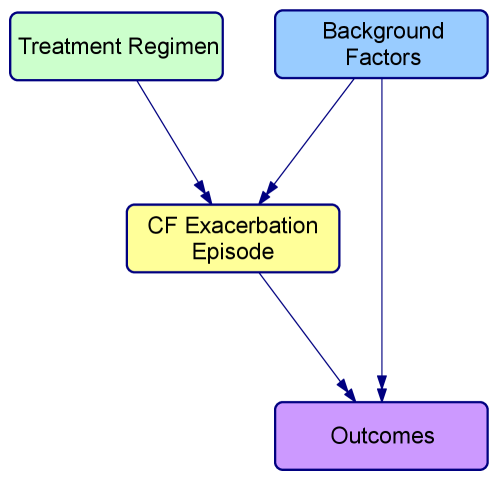
- Methodology Developed a comprehensive Bayesian causal model (DAG/BN) integrating 4 domains (background factors, treatments, exacerbation episode, outcomes) with 30+ nodes representing key pathophysiological processes
- Methodology Implemented a structured expert elicitation process involving 30+ CF clinicians across multiple workshops (2017-2019) using Delphi/nominal group techniques for variable selection and validation
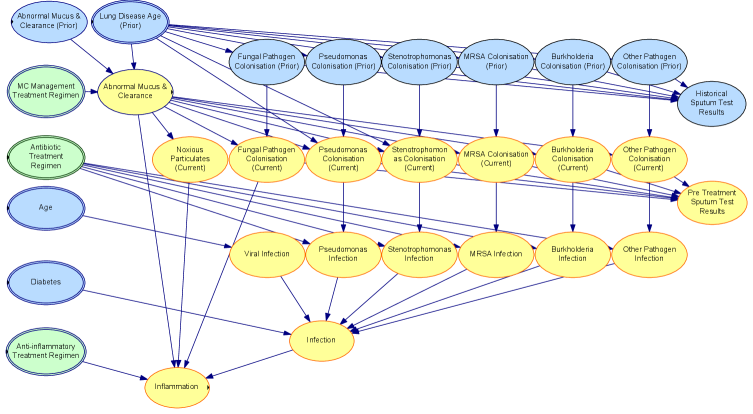
- Biology Explicitly models the causal pathways between abnormal mucus clearance, pathogen colonization (Pseudomonas aeruginosa, MRSA, etc.), infection, and inflammation - enabling targeted treatment effect analysis
主要结论
- The BEAT-CF causal model successfully integrates expert knowledge from 30+ clinicians into a formal DAG structure with 4 domains and 30+ nodes, validated through multiple workshops (2017-2019)
- The framework enables explicit causal inference by identifying necessary adjustments for statistical analyses, directly guiding data collection design for clinical trials
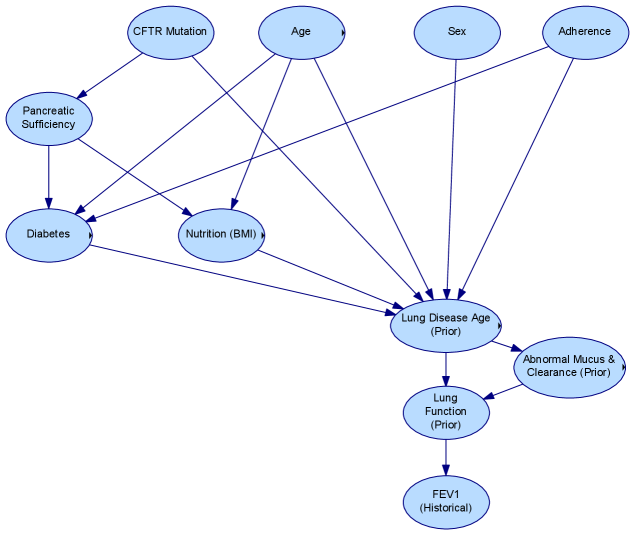
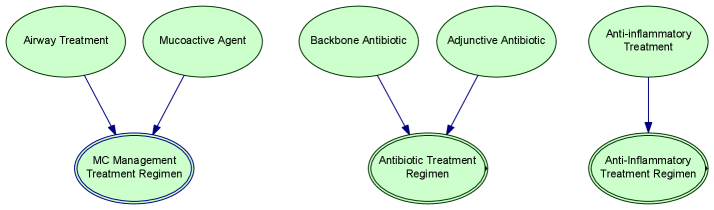
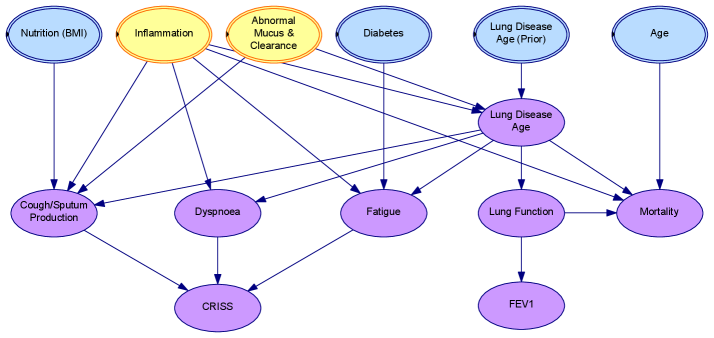
- The model provides a reusable, transparent framework that captures key relationships between background factors (lung disease age, CFTR mutations), treatments (antibiotics, anti-inflammatories), and outcomes (lung function decline, mortality)
摘要: Loss of lung function in cystic fibrosis (CF) occurs progressively, punctuated by acute pulmonary exacerbations (PEx) in which abrupt declines in lung function are not fully recovered. A key component of CF management over the past half century has been the treatment of PEx to slow lung function decline. This has been credited with improvements in survival for people with CF (PwCF), but there is no consensus on the optimal approach to PEx management. BEAT-CF (Bayesian evidence-adaptive treatment of CF) was established to build an evidence-informed knowledge base for CF management. The BEAT-CF causal model is a directed acyclic graph (DAG) and Bayesian network (BN) for PEx that aims to inform the design and analysis of clinical trials comparing the effectiveness of alternative approaches to PEx management. The causal model describes relationships between background risk factors, treatments, and pathogen colonisation of the airways that affect the outcome of an individual PEx episode. The key factors, outcomes, and causal relationships were elicited from CF clinical experts and together represent current expert understanding of the pathophysiology of a PEx episode, guiding the design of data collection and studies and enabling causal inference. Here, we present the DAG that documents this understanding, along with the processes used in its development, providing transparency around our trial design and study processes, as well as a reusable framework for others.