
Paper List
-
Formation of Artificial Neural Assemblies by Biologically Plausible Inhibition Mechanisms
This work addresses the core limitation of the Assembly Calculus model—its fixed-size, biologically implausible k-WTA selection process—by introducing...
-
How to make the most of your masked language model for protein engineering
This paper addresses the critical bottleneck of efficiently sampling high-quality, diverse protein sequences from Masked Language Models (MLMs) for pr...
-
Module control in youth symptom networks across COVID-19
This paper addresses the core challenge of distinguishing whether a prolonged societal stressor (COVID-19) fundamentally reorganizes the architecture ...
-
JEDI: Jointly Embedded Inference of Neural Dynamics
This paper addresses the core challenge of inferring context-dependent neural dynamics from noisy, high-dimensional recordings using a single unified ...
-
ATP Level and Phosphorylation Free Energy Regulate Trigger-Wave Speed and Critical Nucleus Size in Cellular Biochemical Systems
This work addresses the core challenge of quantitatively predicting how the cellular energy state (ATP level and phosphorylation free energy) governs ...
-
Packaging Jupyter notebooks as installable desktop apps using LabConstrictor
This paper addresses the core pain point of ensuring Jupyter notebook reproducibility and accessibility across different computing environments, parti...
-
SNPgen: Phenotype-Supervised Genotype Representation and Synthetic Data Generation via Latent Diffusion
This paper addresses the core challenge of generating privacy-preserving synthetic genotype data that maintains both statistical fidelity and downstre...
-
Continuous Diffusion Transformers for Designing Synthetic Regulatory Elements
This paper addresses the challenge of efficiently generating novel, cell-type-specific regulatory DNA sequences with high predicted activity while min...
The BEAT-CF Causal Model: A model for guiding the design of trials and observational analyses of cystic fibrosis exacerbations
Bayesian Intelligence | Monash University | The Kids Research Institute Australia | University of Sydney | The Children's Hospital at Westmead
30秒速读
IN SHORT: This paper addresses the critical gap in cystic fibrosis exacerbation management by providing a formal causal framework that integrates expert knowledge to guide clinical trial design and enable robust causal inference.
核心创新
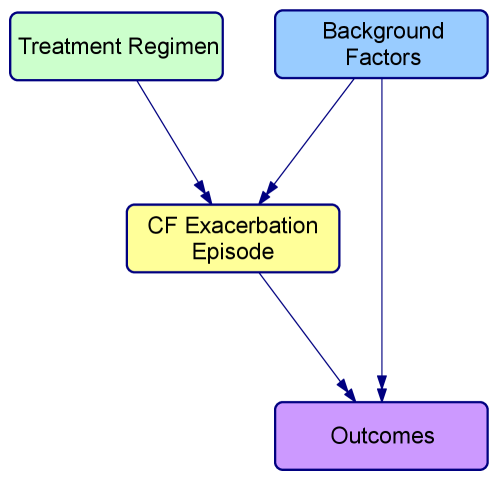
- Methodology Developed a comprehensive Bayesian causal model (DAG/BN) integrating 4 domains (background factors, treatments, exacerbation episode, outcomes) with 30+ nodes representing key pathophysiological processes
- Methodology Implemented a structured expert elicitation process involving 30+ CF clinicians across multiple workshops (2017-2019) using Delphi/nominal group techniques for variable selection and validation
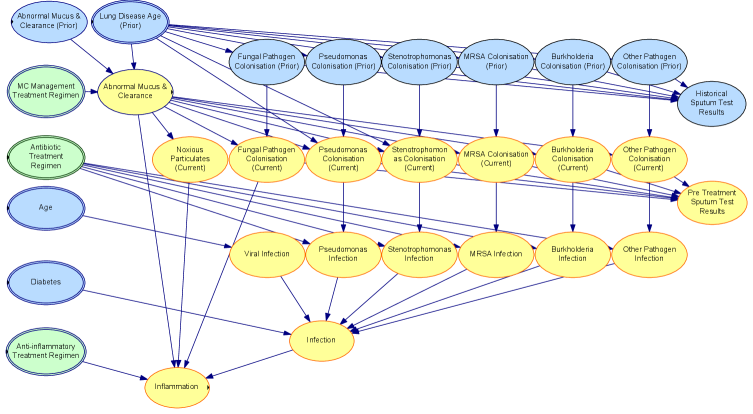
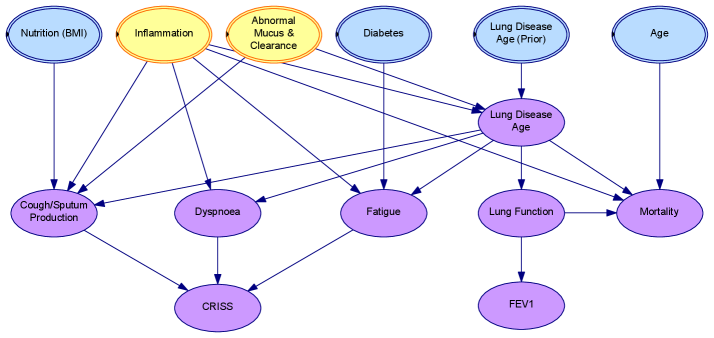
- Biology Explicitly models the causal pathways between abnormal mucus clearance, pathogen colonization (Pseudomonas aeruginosa, MRSA, etc.), infection, and inflammation - enabling targeted treatment effect analysis
主要结论
- The BEAT-CF causal model successfully integrates expert knowledge from 30+ clinicians into a formal DAG structure with 4 domains and 30+ nodes, validated through multiple workshops (2017-2019)
- The framework enables explicit causal inference by identifying necessary adjustments for statistical analyses, directly guiding data collection design for clinical trials
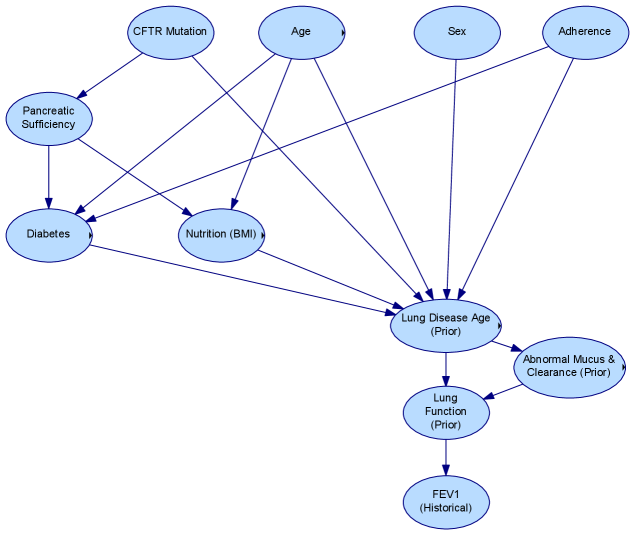
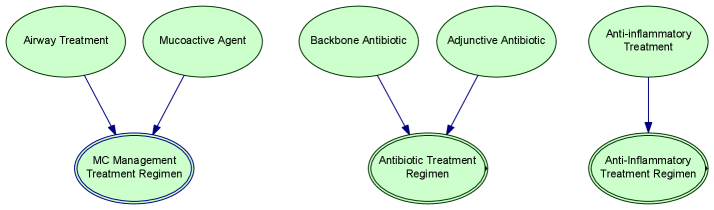
- The model provides a reusable, transparent framework that captures key relationships between background factors (lung disease age, CFTR mutations), treatments (antibiotics, anti-inflammatories), and outcomes (lung function decline, mortality)
摘要: Loss of lung function in cystic fibrosis (CF) occurs progressively, punctuated by acute pulmonary exacerbations (PEx) in which abrupt declines in lung function are not fully recovered. A key component of CF management over the past half century has been the treatment of PEx to slow lung function decline. This has been credited with improvements in survival for people with CF (PwCF), but there is no consensus on the optimal approach to PEx management. BEAT-CF (Bayesian evidence-adaptive treatment of CF) was established to build an evidence-informed knowledge base for CF management. The BEAT-CF causal model is a directed acyclic graph (DAG) and Bayesian network (BN) for PEx that aims to inform the design and analysis of clinical trials comparing the effectiveness of alternative approaches to PEx management. The causal model describes relationships between background risk factors, treatments, and pathogen colonisation of the airways that affect the outcome of an individual PEx episode. The key factors, outcomes, and causal relationships were elicited from CF clinical experts and together represent current expert understanding of the pathophysiology of a PEx episode, guiding the design of data collection and studies and enabling causal inference. Here, we present the DAG that documents this understanding, along with the processes used in its development, providing transparency around our trial design and study processes, as well as a reusable framework for others.