
Paper List
-
The Effective Reproduction Number in the Kermack-McKendrick model with age of infection and reinfection
This paper addresses the challenge of accurately estimating the time-varying effective reproduction number ℛ(t) in epidemics by incorporating two crit...
-
Covering Relations in the Poset of Combinatorial Neural Codes
This work addresses the core challenge of navigating the complex poset structure of neural codes to systematically test the conjecture linking convex ...
-
Collective adsorption of pheromones at the water-air interface
This paper addresses the core challenge of understanding how amphiphilic pheromones, previously assumed to be transported in the gas phase, can be sta...
-
pHapCompass: Probabilistic Assembly and Uncertainty Quantification of Polyploid Haplotype Phase
This paper addresses the core challenge of accurately assembling polyploid haplotypes from sequencing data, where read assignment ambiguity and an exp...
-
Setting up for failure: automatic discovery of the neural mechanisms of cognitive errors
This paper addresses the core challenge of automating the discovery of biologically plausible recurrent neural network (RNN) dynamics that can replica...
-
Influence of Object Affordance on Action Language Understanding: Evidence from Dynamic Causal Modeling Analysis
This study addresses the core challenge of moving beyond correlational evidence to establish the *causal direction* and *temporal dynamics* of how obj...
-
Revealing stimulus-dependent dynamics through statistical complexity
This paper addresses the core challenge of detecting stimulus-specific patterns in neural population dynamics that remain hidden to traditional variab...
-
Exactly Solvable Population Model with Square-Root Growth Noise and Cell-Size Regulation
This paper addresses the fundamental gap in understanding how microscopic growth fluctuations, specifically those with size-dependent (square-root) no...
Approximate Bayesian Inference on Mechanisms of Network Growth and Evolution
Harvard T.H. Chan School of Public Health
30秒速读
IN SHORT: This paper addresses the core challenge of inferring the relative contributions of multiple, simultaneous generative mechanisms in network formation when the true likelihood is intractable.
核心创新
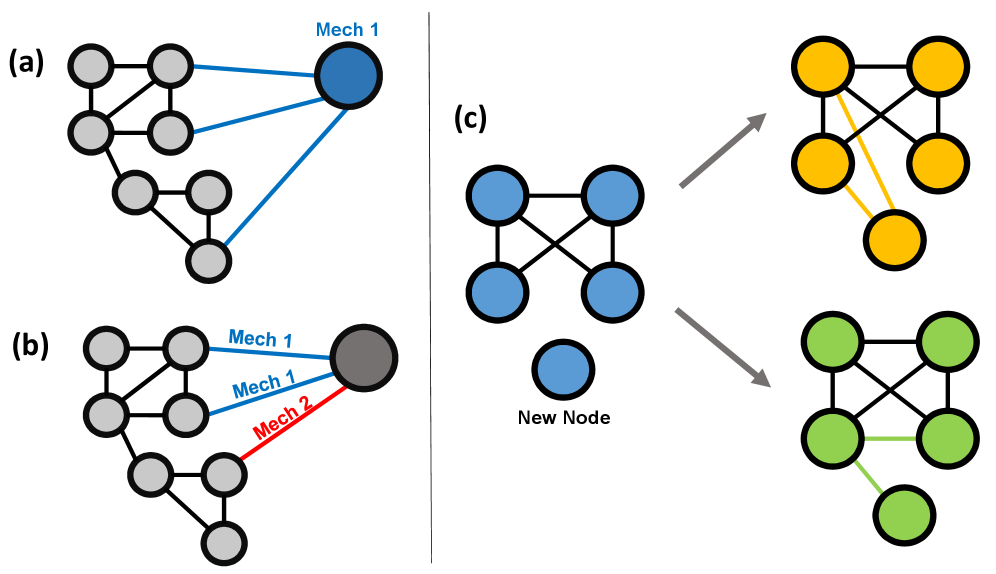
- Methodology Proposes an event-wise mixture-of-mechanisms model that assigns generative rules (e.g., Preferential Attachment, Random Attachment) to each edge formation event, rather than to nodes, increasing model flexibility and realism.
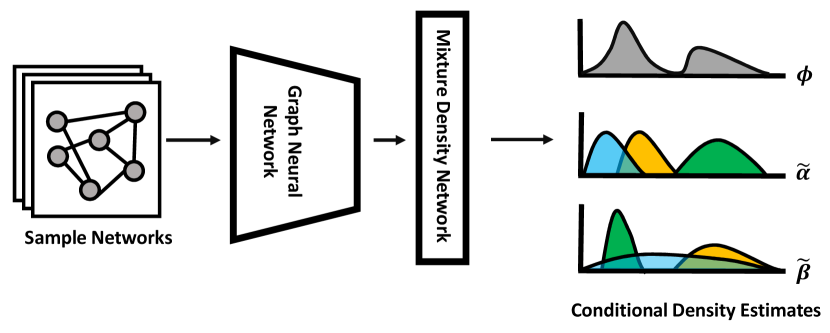
- Methodology Introduces a novel GNN-MDN (Graph Neural Network - Mixture Density Network) architecture that automatically learns informative, low-dimensional network embeddings for conditional density estimation, bypassing the need for manually specified summary statistics.
- Theory Formalizes a unified framework that incorporates both growth mechanisms (adding nodes/edges) and evolution mechanisms (modifying existing edges), allowing the model to capture a wider range of network dynamics like triangle formation.
主要结论
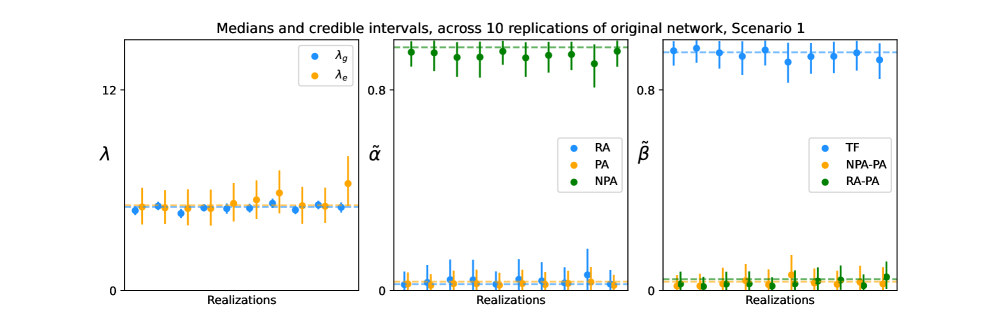
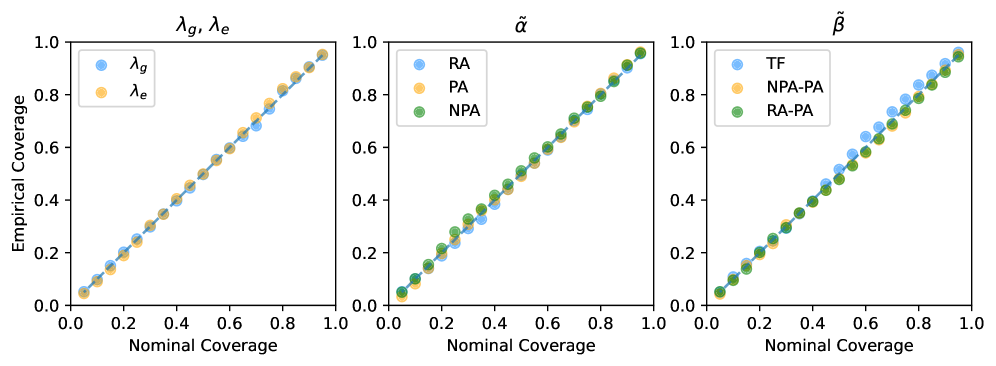
- The proposed GNN-MDN method provides valid approximate Bayesian inference, demonstrated via simulation studies showing that the 95% credible intervals achieve nominal coverage (e.g., containing the true parameter values).
- The event-wise model successfully infers dominant mechanisms in simulated scenarios; for instance, it accurately recovers a weight vector of (0.95, 0.025, 0.025) for a scenario where Preferential Attachment is the primary growth mechanism.
- The method is applicable to real-world networks, providing interpretable decompositions of their formation processes into quantifiable contributions from mechanisms like Random Attachment, Preferential Attachment, and Triangle Formation.
摘要: Mechanistic models can provide an intuitive and interpretable explanation of network growth by specifying a set of generative rules. These rules can be defined by domain knowledge about real-world mechanisms governing network growth or may be designed to facilitate the appearance of certain network motifs. In the formation of real-world networks, multiple mechanisms may be simultaneously involved; it is then important to understand the relative contribution of each of these mechanisms. In this paper, we propose the use of a conditional density estimator, augmented with a graph neural network, to perform inference on a flexible mixture of network-forming mechanisms. This event-wise mixture-of-mechanisms model assigns mechanisms to each edge formation event rather than stipulating node-level mechanisms, thus allowing for an explanation of the network generation process, as well as the dynamic evolution of the network over time. We demonstrate that our approximate Bayesian approach yields valid inferences for the relative weights of the mechanisms in our model, and we utilize this method to investigate the mechanisms behind the formation of a variety of real-world networks.