
Paper List
-
STAR-GO: Improving Protein Function Prediction by Learning to Hierarchically Integrate Ontology-Informed Semantic Embeddings
This paper addresses the core challenge of generalizing protein function prediction to unseen or newly introduced Gene Ontology (GO) terms by overcomi...
-
Incorporating indel channels into average-case analysis of seed-chain-extend
This paper addresses the core pain point of bridging the theoretical gap for the widely used seed-chain-extend heuristic by providing the first rigoro...
-
Competition, stability, and functionality in excitatory-inhibitory neural circuits
This paper addresses the core challenge of extending interpretable energy-based frameworks to biologically realistic asymmetric neural networks, where...
-
Enhancing Clinical Note Generation with ICD-10, Clinical Ontology Knowledge Graphs, and Chain-of-Thought Prompting Using GPT-4
This paper addresses the core challenge of generating accurate and clinically relevant patient notes from sparse inputs (ICD codes and basic demograph...
-
Learning From Limited Data and Feedback for Cell Culture Process Monitoring: A Comparative Study
This paper addresses the core challenge of developing accurate real-time bioprocess monitoring soft sensors under severe data constraints: limited his...
-
Cell-cell communication inference and analysis: biological mechanisms, computational approaches, and future opportunities
This review addresses the critical need for a systematic framework to navigate the rapidly expanding landscape of computational methods for inferring ...
-
Generating a Contact Matrix for Aged Care Settings in Australia: an agent-based model study
This study addresses the critical gap in understanding heterogeneous contact patterns within aged care facilities, where existing population-level con...
-
Emergent Spatiotemporal Dynamics in Large-Scale Brain Networks with Next Generation Neural Mass Models
This work addresses the core challenge of understanding how complex, brain-wide spatiotemporal patterns emerge from the interaction of biophysically d...
Emergent Bayesian Behaviour and Optimal Cue Combination in LLMs
Huawei Noah’s Ark Lab, London, UK | AI Centre, Department of Computer Science, University College London, London, UK
30秒速读
IN SHORT: This paper addresses the critical gap in understanding whether LLMs spontaneously develop human-like Bayesian strategies for processing uncertain information, revealing that high accuracy does not guarantee robust multimodal integration.
核心创新
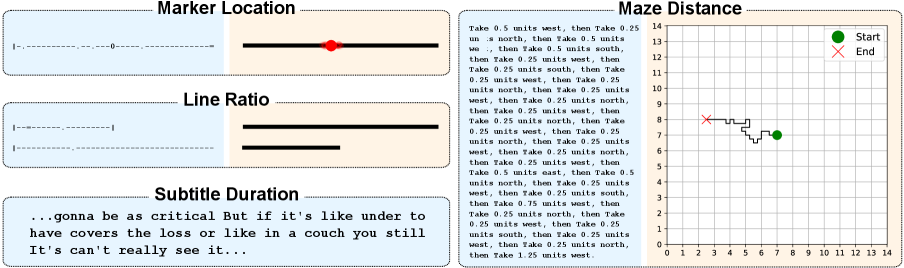
- Methodology Introduces BayesBench, the first psychophysics-inspired behavioral benchmark for LLMs with four magnitude estimation tasks (length, location, distance, duration) across text and image modalities.
- Methodology Develops Bayesian Consistency Score (BCS) to detect Bayes-consistent behavioral shifts even when accuracy saturates, enabling separation of capability from computational strategy.
- Biology Demonstrates emergent Bayesian behavior in capable LLMs without explicit training, with Llama-4 Maverick showing cue-combination efficiency exceeding human biological systems (RRE > 1 against Bayesian oracle).
主要结论
- GPT-5 Mini achieves perfect text accuracy (NRMSE ≈ 0) but fails to integrate visual cues efficiently, showing poor cue-combination efficiency (RRE < 1) despite high capability.
- Llama-4 Maverick demonstrates emergent Bayesian behavior with cue-combination efficiency exceeding Bayesian reliability-weighted baselines (RRE > 1), suggesting non-linear integration strategies.
- Bayesian Consistency Score reveals that more accurate models show stronger evidence of Bayesian behavior, with BCS positively correlated with accuracy across nine evaluated LLMs.
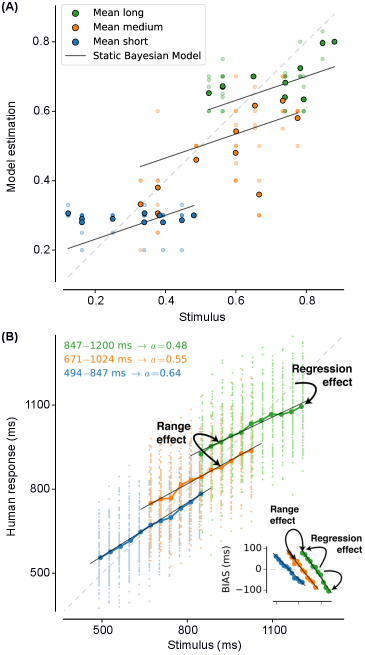
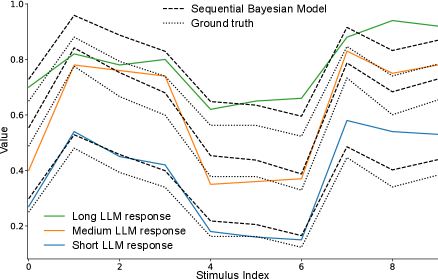
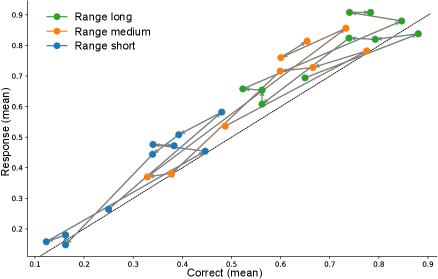
摘要: Large language models (LLMs) excel at explicit reasoning, but their implicit computational strategies remain underexplored. Decades of psychophysics research show that humans intuitively process and integrate noisy signals using near-optimal Bayesian strategies in perceptual tasks. We ask whether LLMs exhibit similar behaviour and perform optimal multimodal integration without explicit training or instruction. Adopting the psychophysics paradigm, we infer computational principles of LLMs from systematic behavioural studies. We introduce a behavioural benchmark - BayesBench: four magnitude estimation tasks (length, location, distance, and duration) over text and image, inspired by classic psychophysics, and evaluate a diverse set of nine LLMs alongside human judgments for calibration. Through controlled ablations of noise, context, and instruction prompts, we measure performance, behaviour and efficiency in multimodal cue-combination. Beyond accuracy and efficiency metrics, we introduce a Bayesian Consistency Score that detects Bayes-consistent behavioural shifts even when accuracy saturates. Our results show that while capable models often adapt in Bayes-consistent ways, accuracy does not guarantee robustness. Notably, GPT-5 Mini achieves perfect text accuracy but fails to integrate visual cues efficiently. This reveals a critical dissociation between capability and strategy, suggesting accuracy-centric benchmarks may over-index on performance while missing brittle uncertainty handling. These findings reveal emergent principled handling of uncertainty and highlight the correlation between accuracy and Bayesian tendencies. We release our psychophysics benchmark and consistency metric as evaluation tools and to inform future multimodal architecture designs111Project webpage: https://bayes-bench.github.io.