
Paper List
-
Discovery of a Hematopoietic Manifold in scGPT Yields a Method for Extracting Performant Algorithms from Biological Foundation Model Internals
This work addresses the core challenge of extracting reusable, interpretable, and high-performance biological algorithms from the opaque internal repr...
-
MS2MetGAN: Latent-space adversarial training for metabolite–spectrum matching in MS/MS database search
This paper addresses the critical bottleneck in metabolite identification: the generation of high-quality negative training samples that are structura...
-
Toward Robust, Reproducible, and Widely Accessible Intracranial Language Brain-Computer Interfaces: A Comprehensive Review of Neural Mechanisms, Hardware, Algorithms, Evaluation, Clinical Pathways and Future Directions
This review addresses the core challenge of fragmented and heterogeneous evidence that hinders the clinical translation of intracranial language BCIs,...
-
Less Is More in Chemotherapy of Breast Cancer
通过纳入细胞周期时滞和竞争项,解决了现有肿瘤-免疫模型的过度简化问题,以定量比较化疗方案。
-
Fold-CP: A Context Parallelism Framework for Biomolecular Modeling
This paper addresses the critical bottleneck of GPU memory limitations that restrict AlphaFold 3-like models to processing only a few thousand residue...
-
Open Biomedical Knowledge Graphs at Scale: Construction, Federation, and AI Agent Access with Samyama Graph Database
This paper addresses the core pain point of fragmented biomedical data by constructing and federating large-scale, open knowledge graphs to enable sea...
-
Predictive Analytics for Foot Ulcers Using Time-Series Temperature and Pressure Data
This paper addresses the critical need for continuous, real-time monitoring of diabetic foot health by developing an unsupervised anomaly detection fr...
-
Hypothesis-Based Particle Detection for Accurate Nanoparticle Counting and Digital Diagnostics
This paper addresses the core challenge of achieving accurate, interpretable, and training-free nanoparticle counting in digital diagnostic assays, wh...
Assessment of Simulation-based Inference Methods for Stochastic Compartmental Models
Bonn Center for Mathematical Life Sciences, University of Bonn | Life and Medical Science Institute, University of Bonn | Institute of Software Technology, German Aerospace Center (DLR)
30秒速读
IN SHORT: This paper addresses the core challenge of performing accurate Bayesian parameter inference for stochastic epidemic models when the likelihood function is intractable, a common bottleneck for real-time forecasting.
核心创新
- Methodology Provides the first comprehensive, praxis-driven comparison between Particle Filters (PF) and Conditional Normalizing Flows (CNF) for inference on stochastic compartmental models, benchmarking their performance head-to-head.
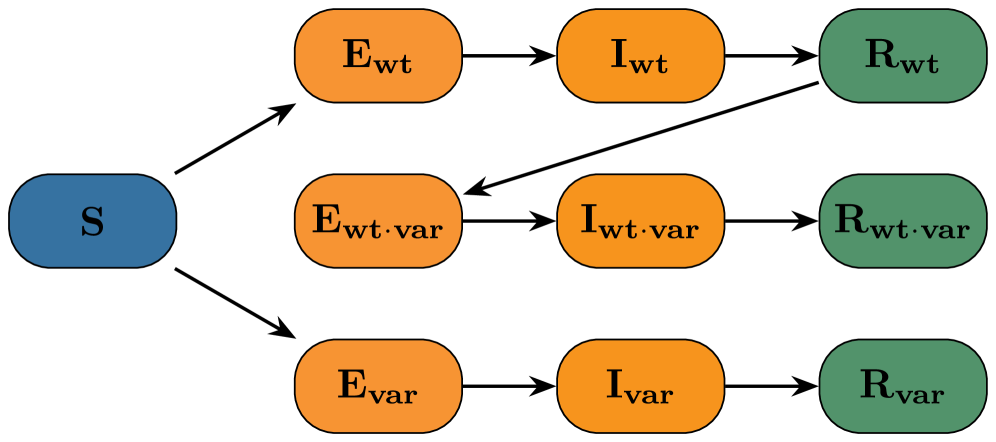
- Methodology Demonstrates the application and robustness of these likelihood-free methods on a complex, non-identifiable two-variant SEIR model with real-world data from an Ethiopian COVID-19 cohort, including scenarios with irregular sampling and missing data.
- Theory Shows that parameter space reparameterization (e.g., using R0, e0, s0) can mitigate ill-conditioning in complex models, improving posterior alignment between PF and CNF methods.
主要结论
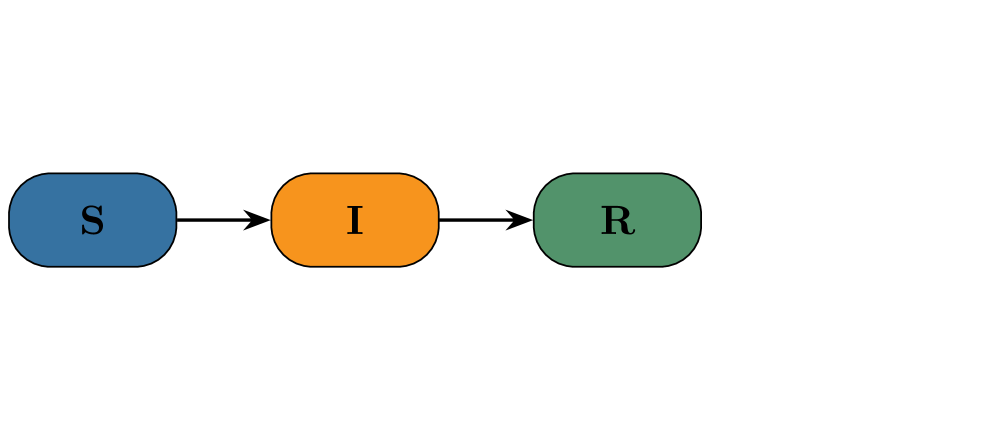
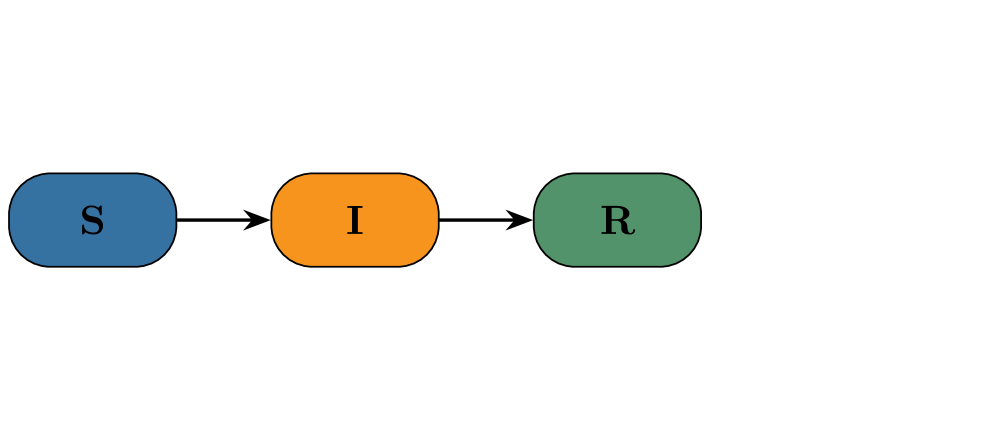
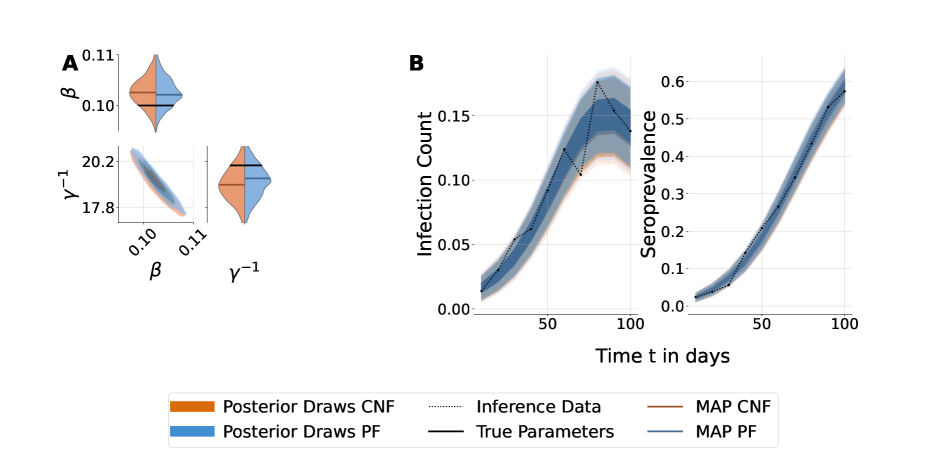
- Both PF and CNF provided robust and reliable inference on the stochastic SIR model with synthetic data, validating the implementation framework.
- For the complex two-variant SEIR model, both methods yielded good fits to synthetic data, but ill-conditioning led to differences in marginal posterior shapes; reparameterization with dimension reduction improved posterior alignment.
- Application to real Ethiopian cohort data demonstrated the operational robustness of both PF and CNF under conditions of real-world noise and irregular data sampling, proving their practical utility.
摘要: Global pandemics, such as the recent COVID-19 crisis, highlight the need for stochastic epidemic models that can capture the randomness inherent in the spread of disease. Such models must be accompanied by methods for estimating parameters in order to generate fast nowcasts and short-term forecasts that can inform public health decisions. This paper presents a comparison of two advanced Bayesian inference methods: 1) pseudo-marginal particle Markov chain Monte Carlo, short Particle Filters (PF), and 2) Conditional Normalizing Flows (CNF). We investigate their performance on two commonly used compartmental models: a classical Susceptible-Infected-Recovered (SIR) model and a two-variant Susceptible-Exposed-Infected-Recovered (SEIR) model, complemented by an observation model that maps latent trajectories to empirical data. Addressing the challenges of intractable likelihoods for parameter inference in stochastic settings, our analysis highlights how these likelihood-free methods provide accurate and robust inference capabilities. The results of our simulation study further underscore the effectiveness of these approaches in capturing the stochastic dynamics of epidemics, providing prediction capabilities for the control of epidemic outbreaks. Results on an Ethiopian cohort study demonstrate operational robustness under real‑world noise and irregular data sampling. To facilitate reuse and to enable building pipelines that ultimately contribute to better informed decision making in public health, we make code and synthetic datasets publicly available.