
Paper List
-
STAR-GO: Improving Protein Function Prediction by Learning to Hierarchically Integrate Ontology-Informed Semantic Embeddings
This paper addresses the core challenge of generalizing protein function prediction to unseen or newly introduced Gene Ontology (GO) terms by overcomi...
-
Incorporating indel channels into average-case analysis of seed-chain-extend
This paper addresses the core pain point of bridging the theoretical gap for the widely used seed-chain-extend heuristic by providing the first rigoro...
-
Competition, stability, and functionality in excitatory-inhibitory neural circuits
This paper addresses the core challenge of extending interpretable energy-based frameworks to biologically realistic asymmetric neural networks, where...
-
Enhancing Clinical Note Generation with ICD-10, Clinical Ontology Knowledge Graphs, and Chain-of-Thought Prompting Using GPT-4
This paper addresses the core challenge of generating accurate and clinically relevant patient notes from sparse inputs (ICD codes and basic demograph...
-
Learning From Limited Data and Feedback for Cell Culture Process Monitoring: A Comparative Study
This paper addresses the core challenge of developing accurate real-time bioprocess monitoring soft sensors under severe data constraints: limited his...
-
Cell-cell communication inference and analysis: biological mechanisms, computational approaches, and future opportunities
This review addresses the critical need for a systematic framework to navigate the rapidly expanding landscape of computational methods for inferring ...
-
Generating a Contact Matrix for Aged Care Settings in Australia: an agent-based model study
This study addresses the critical gap in understanding heterogeneous contact patterns within aged care facilities, where existing population-level con...
-
Emergent Spatiotemporal Dynamics in Large-Scale Brain Networks with Next Generation Neural Mass Models
This work addresses the core challenge of understanding how complex, brain-wide spatiotemporal patterns emerge from the interaction of biophysically d...
Pharmacophore-based design by learning on voxel grids
AIDD, Genentech
30秒速读
IN SHORT: This paper addresses the computational bottleneck and limited novelty in conventional pharmacophore-based virtual screening by introducing a voxel captioning method that generates novel molecules directly from 3D pharmacophore-shape profiles.
核心创新
- Methodology Proposes VoxCap, the first voxel captioning method for generating SMILES strings from voxelized 3D pharmacophore-shape profiles, bridging 3D structural information with 1D string generation.
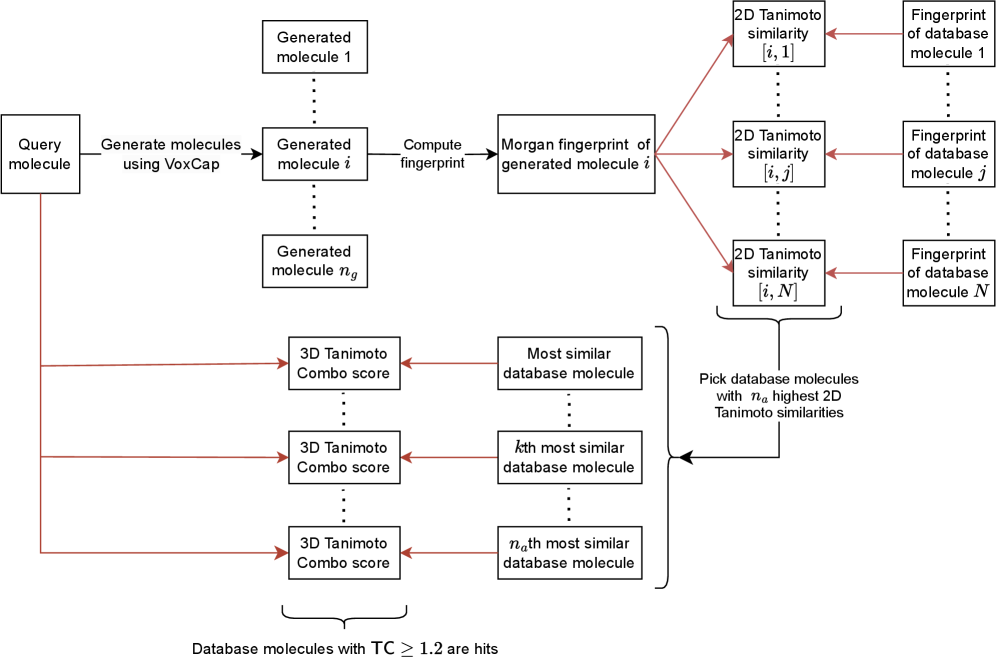
- Methodology Introduces a 'fast search' workflow that reduces computational complexity from O(database size) to O(n_g × n_a), enabling screening of billion-compound libraries previously considered intractable.
- Biology Demonstrates superior performance in generating diverse, novel scaffolds with high pharmacophore-shape similarity (Tanimoto Combo score ≥1.2), addressing both in-distribution and out-of-distribution query molecules.
主要结论
- VoxCap generates significantly more hits than baseline methods, with median hits per query increasing from 0 (baseline) to 116.5 on GEOM-drugs and from 0 to 115 on ChEMBL (p<0.001).
- The model produces diverse scaffolds, with median unique scaffold hits of 55.5 (GEOM-drugs) and 72 (ChEMBL), compared to 0 for baselines and 7-8.5 for PGMG.
- The fast search workflow reduces computational requirements by orders of magnitude while maintaining hit rates, enabling practical screening of billion-compound libraries like Enamine Real (60B compounds).
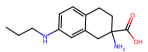
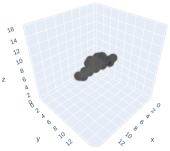
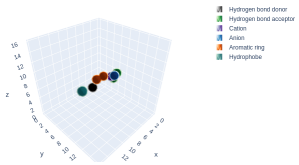
摘要: Ligand-based drug discovery (LBDD) relies on making use of known binders to a protein target to find structurally diverse molecules similarly likely to bind. This process typically involves a brute force search of the known binder (query) against a molecular library using some metric of molecular similarity. One popular approach overlays the pharmacophore-shape profile of the known binder to 3D conformations enumerated for each of the library molecules, computes overlaps, and picks a set of diverse library molecules with high overlaps. While this virtual screening workflow has had considerable success in hit diversification, scaffold hopping, and patent busting, it scales poorly with library sizes and restricts candidate generation to existing library compounds. Leveraging recent advances in voxel-based generative modelling, we propose a pharmacophore-based generative model and workflows that address the scaling and fecundity issues of conventional pharmacophore-based virtual screening. We introduce VoxCap, a voxel captioning method for generating SMILES strings from voxelised molecular representations.We propose two workflows as practical use cases as well as benchmarks for pharmacophore-based generation: de-novo design, in which we aim to generate new molecules with high pharmacophore-shape similarities to query molecules, and fast search, which aims to combine generative design with a cheap 2D substructure similarity search for efficient hit identification. Our results show that VoxCap significantly outperforms previous methods in generating diverse de-novo hits. When combined with our fast search workflow, VoxCap reduces computational time by orders of magnitude while returning hits for all query molecules, enabling the search of large libraries that are intractable to search by brute force.