
Paper List
-
Evolutionarily Stable Stackelberg Equilibrium
通过要求追随者策略对突变入侵具有鲁棒性,弥合了斯塔克尔伯格领导力模型与演化稳定性之间的鸿沟。
-
Recovering Sparse Neural Connectivity from Partial Measurements: A Covariance-Based Approach with Granger-Causality Refinement
通过跨多个实验会话累积协方差统计,实现从部分记录到完整神经连接性的重建。
-
Atomic Trajectory Modeling with State Space Models for Biomolecular Dynamics
ATMOS通过提供一个基于SSM的高效框架,用于生物分子的原子级轨迹生成,弥合了计算昂贵的MD模拟与时间受限的深度生成模型之间的差距。
-
Slow evolution towards generalism in a model of variable dietary range
通过证明是种群统计噪声(而非确定性动力学)驱动了模式形成和泛化食性的演化,解决了间接竞争下物种形成的悖论。
-
Grounded Multimodal Retrieval-Augmented Drafting of Radiology Impressions Using Case-Based Similarity Search
通过将印象草稿基于检索到的历史病例,并采用明确引用和基于置信度的拒绝机制,解决放射学报告生成中的幻觉问题。
-
Unified Policy–Value Decomposition for Rapid Adaptation
通过双线性分解在策略和价值函数之间共享低维目标嵌入,实现对新颖任务的零样本适应。
-
Mathematical Modeling of Cancer–Bacterial Therapy: Analysis and Numerical Simulation via Physics-Informed Neural Networks
提供了一个严格的、无网格的PINN框架,用于模拟和分析细菌癌症疗法中复杂的、空间异质的相互作用。
-
Sample-Efficient Adaptation of Drug-Response Models to Patient Tumors under Strong Biological Domain Shift
通过从无标记分子谱中学习可迁移表征,利用最少的临床数据实现患者药物反应的有效预测。
Reinventing Clinical Dialogue: Agentic Paradigms for LLM‑Enabled Healthcare Communication
College of Management and Economics, Laboratory of Computation and Analytics of Complex Management Systems (CACMS), Tianjin University | Computer Network Information Center, Chinese Academy of Sciences
30秒速读
IN SHORT: This paper addresses the core challenge of transforming reactive, stateless LLMs into autonomous, reliable clinical dialogue agents capable of longitudinal patient management and verifiable decision-making within the stringent safety constraints of healthcare.
核心创新
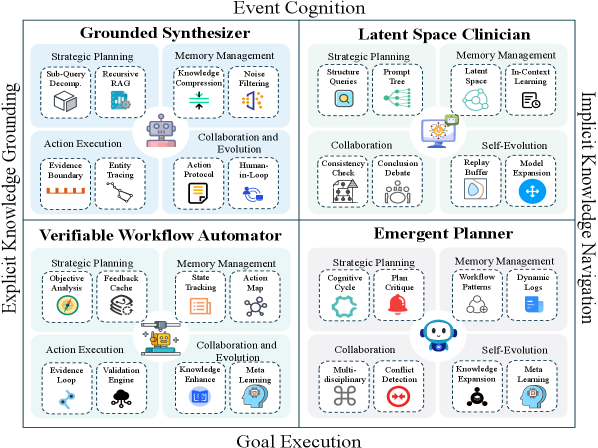
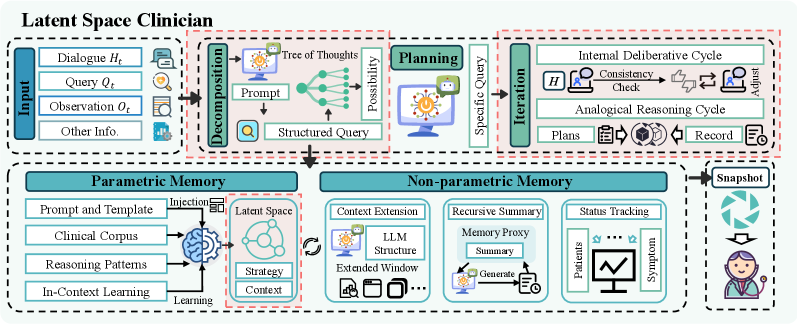
- Methodology Introduces a novel taxonomy for clinical dialogue agents based on two orthogonal axes: Knowledge Source and Agency Objective, categorizing systems into four distinct paradigms (Latent Space Clinicians, Emergent Planners, Grounded Synthesizers, Verifiable Workflow Automators).
- Methodology Provides a first-principles, in-depth analysis of the core cognitive components (planning, memory, action, collaboration, evolution) across the proposed paradigms, moving beyond surface-level application cataloging.
- Theory Formalizes clinical dialogue as a Partially Observable Markov Decision Process (POMDP), mathematically framing the agent's task as state estimation and long-term utility optimization, bridging abstract AI theory with clinical rigor.
主要结论
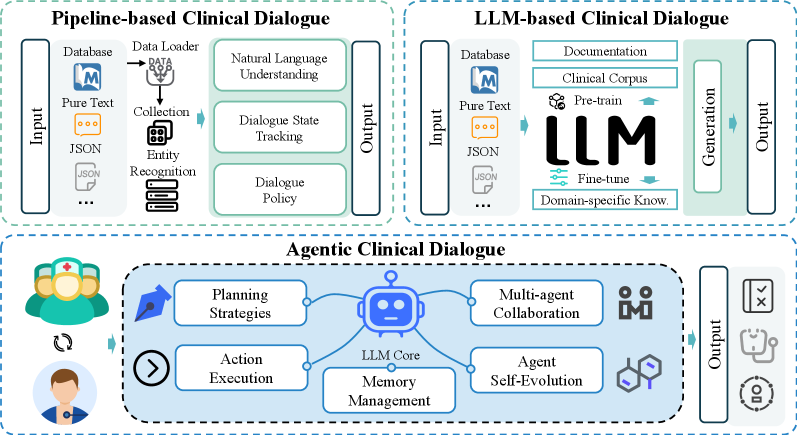
- The agentic paradigm, operationalized through five core components (planning, memory, action, collaboration, evolution), is essential to overcome the reactive and stateless limitations of foundational LLMs for complex clinical tasks.
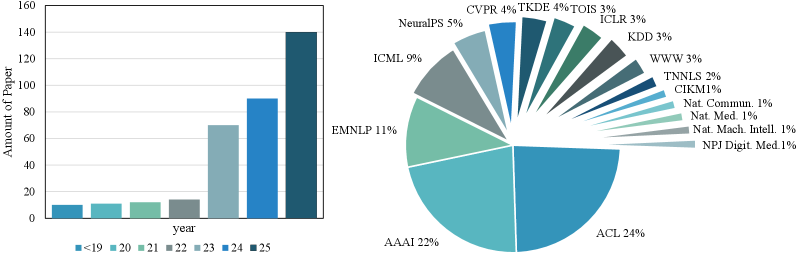
- A taxonomy based on Knowledge Source and Agency Objective reveals fundamental trade-offs between creativity/reliability and autonomy/safety, providing a systematic framework for designing clinical agents (analysis based on a review of over 300 papers).
- Effective clinical dialogue requires modeling the interaction as a POMDP to handle information asymmetry, where the agent must maintain a belief state (b_t) and optimize a policy (π*) for long-term clinical utility, as formalized in Eq. 1 and Eq. 2.
摘要: Clinical dialogue represents a complex duality requiring both the empathetic fluency of natural conversation and the rigorous precision of evidence-based medicine. While Large Language Models possess unprecedented linguistic capabilities, their architectural reliance on reactive and stateless processing often favors probabilistic plausibility over factual veracity. This structural limitation has catalyzed a paradigm shift in medical AI from generative text prediction to agentic autonomy, where the model functions as a central reasoning engine capable of deliberate planning and persistent memory. Moving beyond existing reviews that primarily catalog downstream applications, this survey provides a first-principles analysis of the cognitive architecture underpinning this shift. We introduce a novel taxonomy structured along the orthogonal axes of knowledge source and agency objective to delineate the provenance of clinical knowledge against the system’s operational scope. This framework facilitates a systematic analysis of the intrinsic trade-offs between creativity and reliability by categorizing methods into four archetypes: Latent Space Clinicians, Emergent Planners, Grounded Synthesizers, and Verifiable Workflow Automators. For each paradigm, we deconstruct the technical realization across the entire cognitive pipeline, encompassing strategic planning, memory management, action execution, collaboration, and evolution to reveal how distinct architectural choices balance the tension between autonomy and safety. Furthermore, we bridge abstract design philosophies with the pragmatic implementation ecosystem. By mapping real-world applications to our taxonomy and systematically reviewing benchmarks and evaluation metrics specific to clinical agents, we provide a comprehensive reference for future development. Finally, we identify critical frontiers regarding trustworthiness, outlining a roadmap for future research to foster reliable and ethically aligned healthcare AI. The latest papers and related resources are maintained on our website.