
Paper List
-
Discovery of a Hematopoietic Manifold in scGPT Yields a Method for Extracting Performant Algorithms from Biological Foundation Model Internals
This work addresses the core challenge of extracting reusable, interpretable, and high-performance biological algorithms from the opaque internal repr...
-
MS2MetGAN: Latent-space adversarial training for metabolite–spectrum matching in MS/MS database search
This paper addresses the critical bottleneck in metabolite identification: the generation of high-quality negative training samples that are structura...
-
Toward Robust, Reproducible, and Widely Accessible Intracranial Language Brain-Computer Interfaces: A Comprehensive Review of Neural Mechanisms, Hardware, Algorithms, Evaluation, Clinical Pathways and Future Directions
This review addresses the core challenge of fragmented and heterogeneous evidence that hinders the clinical translation of intracranial language BCIs,...
-
Less Is More in Chemotherapy of Breast Cancer
通过纳入细胞周期时滞和竞争项,解决了现有肿瘤-免疫模型的过度简化问题,以定量比较化疗方案。
-
Fold-CP: A Context Parallelism Framework for Biomolecular Modeling
This paper addresses the critical bottleneck of GPU memory limitations that restrict AlphaFold 3-like models to processing only a few thousand residue...
-
Open Biomedical Knowledge Graphs at Scale: Construction, Federation, and AI Agent Access with Samyama Graph Database
This paper addresses the core pain point of fragmented biomedical data by constructing and federating large-scale, open knowledge graphs to enable sea...
-
Predictive Analytics for Foot Ulcers Using Time-Series Temperature and Pressure Data
This paper addresses the critical need for continuous, real-time monitoring of diabetic foot health by developing an unsupervised anomaly detection fr...
-
Hypothesis-Based Particle Detection for Accurate Nanoparticle Counting and Digital Diagnostics
This paper addresses the core challenge of achieving accurate, interpretable, and training-free nanoparticle counting in digital diagnostic assays, wh...
Personalized optimization of pediatric HD-tDCS for dose consistency and target engagement
Southern University of Science and Technology | Brown University | University of Illinois Urbana-Champaign | University of Warwick | Carle Foundation Hospital
30秒速读
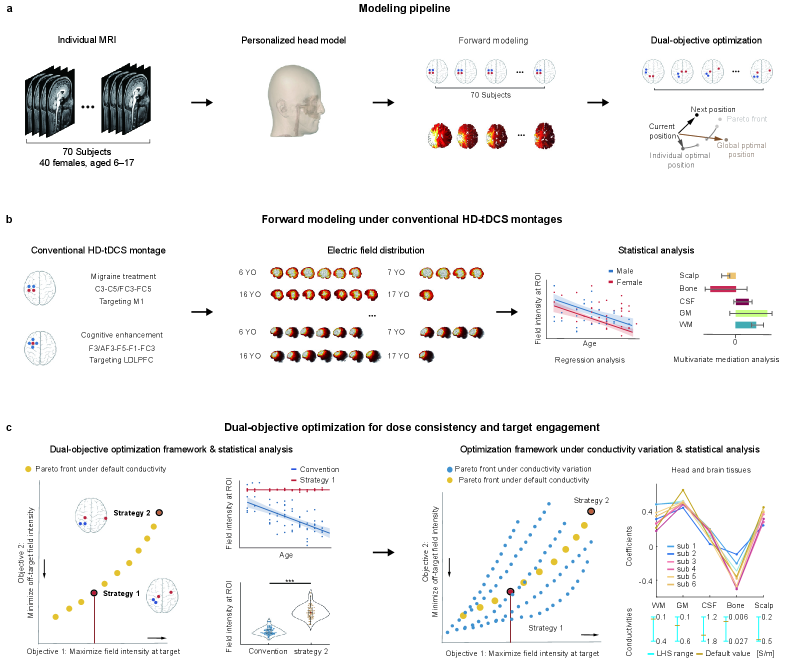
IN SHORT: This paper addresses the critical limitation of one-size-fits-all HD-tDCS protocols in pediatric populations by developing a personalized optimization framework that accounts for developmental anatomical variability and tissue conductivity uncertainty.
核心创新
- Methodology First dual-objective optimization framework for pediatric HD-tDCS that generates personalized Pareto fronts balancing target intensity and focality, enabling systematic trade-off analysis.
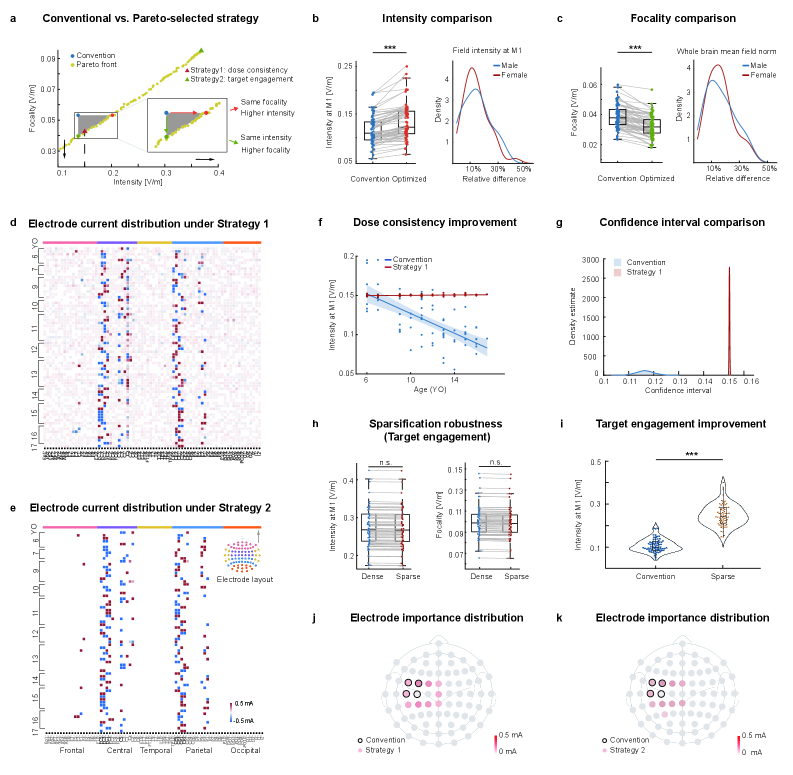
- Methodology Introduction of two clinically actionable strategies: dose-consistency (enforcing fixed target intensity across individuals) and target-engagement (maximizing intensity under safety limits), both robust to conductivity variations.
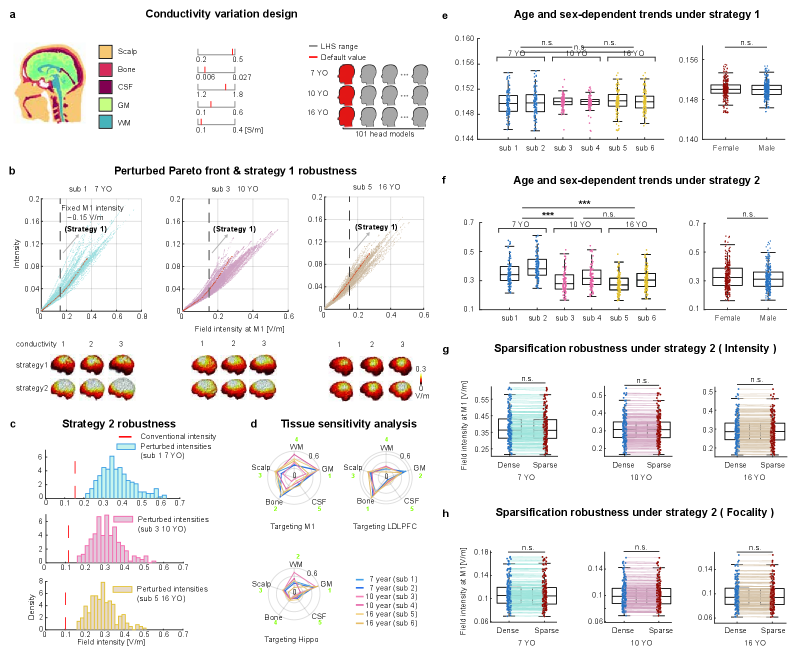
- Biology First systematic quantification of depth-dependent tissue conductivity sensitivity: superficial targets dominated by scalp/bone conductivities (R² up to 0.85), while deep targets shaped by gray/white matter conductivities.
主要结论
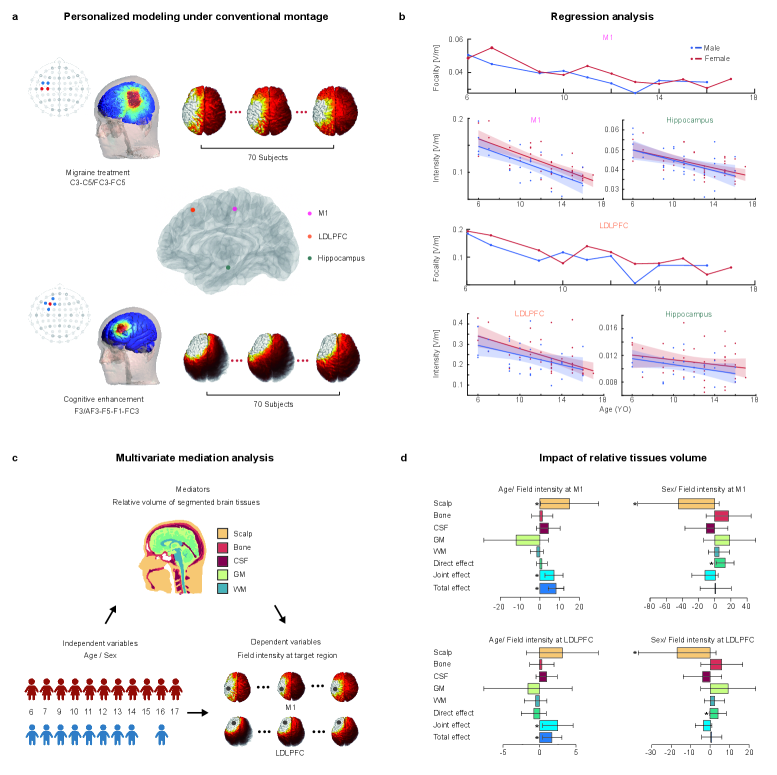
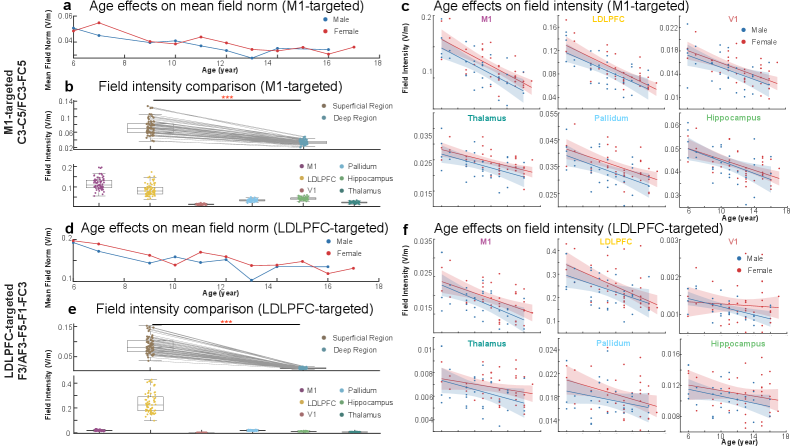
- Conventional montages show significant age-dependent reductions in target intensity (p<0.05, FDR-corrected) and systematic sex differences mediated by scalp volume (mediation effect p<0.05).
- Optimized solutions Pareto-dominate conventional approaches, achieving 15-25% higher focality at matched intensity and 20-30% higher intensity at matched focality (Mann-Whitney U, p<0.001).
- Both optimization strategies remain robust under large conductivity variations (1,800 optimizations across 600 perturbed models), with sparse electrode configurations (<0.1 mA threshold) preserving performance (n.s., Mann-Whitney U).
摘要: High-definition transcranial direct current stimulation (HD-tDCS) dosing in children remains largely empirical, relying on one-size-fits-all protocols despite rapid developmental changes in head anatomy and tissue properties that strongly modulate how transcranial currents reach the developing brain. Using 70 pediatric head models (ages 6–17) and commonly used cortical targets (primary motor cortex and left dorsolateral prefrontal cortex), our forward simulations find that standard montages produce marked age-dependent reductions in target electric-field intensity and systematic sex differences linked to tissue-volume covariation, underscoring the profound limitations of conventional uniform montages. To overcome these limitations, we introduce a developmentally informed, dual-objective optimization framework designed to generate personalized Pareto fronts summarizing the trade-off between electric-field intensity and focality. These subject-specific fronts reveal systematic performance improvements over conventional montages, yielding both higher focality at matched target intensity and higher intensity at matched focality. From these optimized solutions, we derive two clinically practical dosing prescriptions: a dose-consistency strategy that, for the first time, explicitly enforces fixed target intensity across individuals to implicitly mitigate demographic effects, and a target-engagement strategy that maximizes target intensity under safety limits. Both strategies remain robust to large conductivity variations, and we further show that dense HD-tDCS solutions admit sparse equivalents without performance loss under the target-engagement strategy. Across 1,800 optimizations in 600 conductivity-perturbed head models, we also find that tissue conductivity sensitivity is depth-dependent, with Pareto-front distributions for superficial cortical targets most influenced by gray matter, scalp, and bone conductivities, and those for a deep target predominantly shaped by gray and white matter conductivities. Together, these results establish a principled framework for pediatric HD-tDCS planning that explicitly accounts for developmental anatomy and physiological uncertainty, enabling reliable and individualized neuromodulation dosing in vulnerable pediatric populations.