
Paper List
-
Macroscopic Dominance from Microscopic Extremes: Symmetry Breaking in Spatial Competition
This paper addresses the fundamental question of how microscopic stochastic advantages in spatial exploration translate into macroscopic resource domi...
-
Linear Readout of Neural Manifolds with Continuous Variables
This paper addresses the core challenge of quantifying how the geometric structure of high-dimensional neural population activity (neural manifolds) d...
-
Theory of Cell Body Lensing and Phototaxis Sign Reversal in “Eyeless” Mutants of Chlamydomonas
This paper solves the core puzzle of how eyeless mutants of Chlamydomonas exhibit reversed phototaxis by quantitatively modeling the competition betwe...
-
Cross-Species Transfer Learning for Electrophysiology-to-Transcriptomics Mapping in Cortical GABAergic Interneurons
This paper addresses the challenge of predicting transcriptomic identity from electrophysiological recordings in human cortical interneurons, where li...
-
Uncovering statistical structure in large-scale neural activity with Restricted Boltzmann Machines
This paper addresses the core challenge of modeling large-scale neural population activity (1500-2000 neurons) with interpretable higher-order interac...
-
Realizing Common Random Numbers: Event-Keyed Hashing for Causally Valid Stochastic Models
This paper addresses the critical problem that standard stateful PRNG implementations in agent-based models violate causal validity by making random d...
-
A Standardized Framework for Evaluating Gene Expression Generative Models
This paper addresses the critical lack of standardized evaluation protocols for single-cell gene expression generative models, where inconsistent metr...
-
Single Molecule Localization Microscopy Challenge: A Biologically Inspired Benchmark for Long-Sequence Modeling
This paper addresses the core challenge of evaluating state-space models on biologically realistic, sparse, and stochastic temporal processes, which a...
Personalized optimization of pediatric HD-tDCS for dose consistency and target engagement
Southern University of Science and Technology | Brown University | University of Illinois Urbana-Champaign | University of Warwick | Carle Foundation Hospital
30秒速读
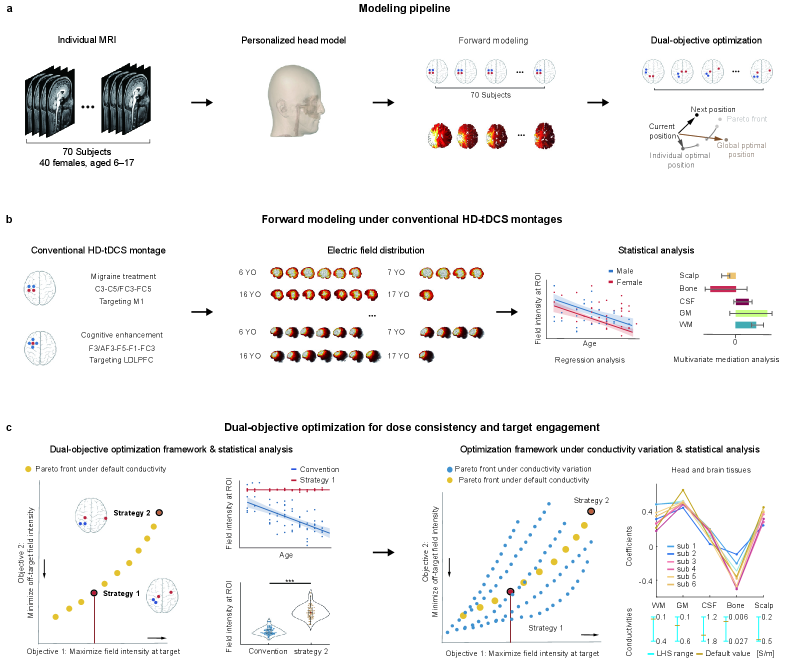
IN SHORT: This paper addresses the critical limitation of one-size-fits-all HD-tDCS protocols in pediatric populations by developing a personalized optimization framework that accounts for developmental anatomical variability and tissue conductivity uncertainty.
核心创新
- Methodology First dual-objective optimization framework for pediatric HD-tDCS that generates personalized Pareto fronts balancing target intensity and focality, enabling systematic trade-off analysis.
- Methodology Introduction of two clinically actionable strategies: dose-consistency (enforcing fixed target intensity across individuals) and target-engagement (maximizing intensity under safety limits), both robust to conductivity variations.
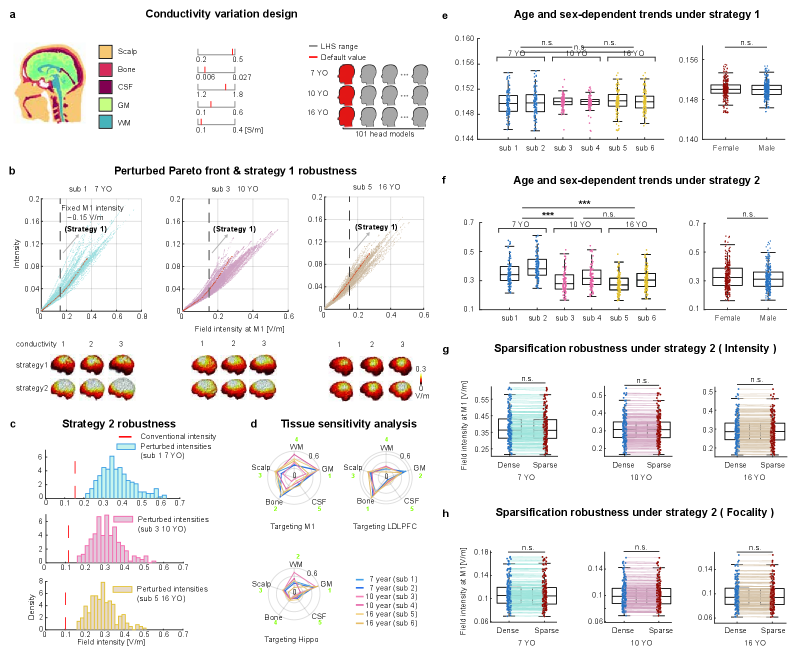
- Biology First systematic quantification of depth-dependent tissue conductivity sensitivity: superficial targets dominated by scalp/bone conductivities (R² up to 0.85), while deep targets shaped by gray/white matter conductivities.
主要结论
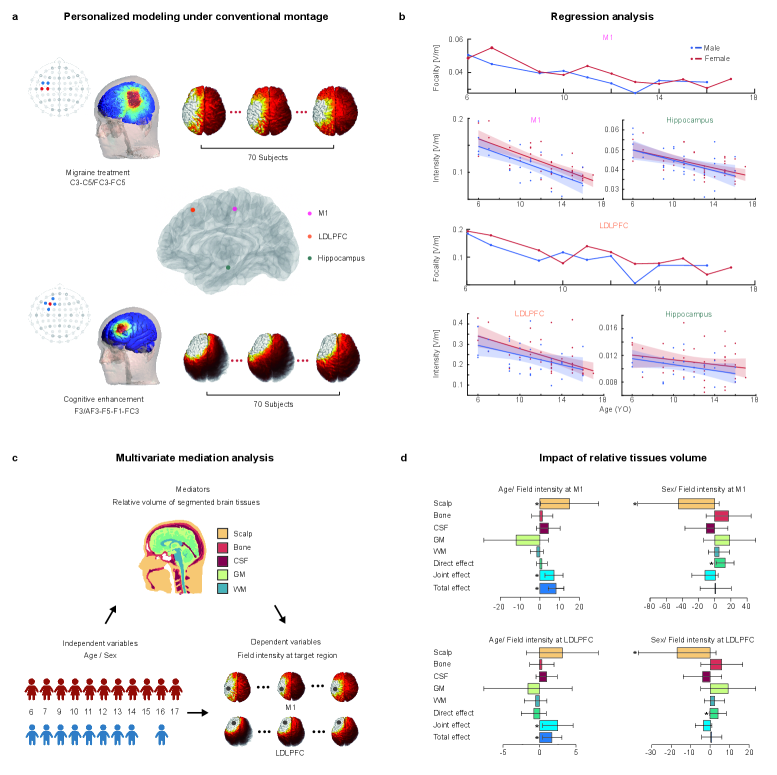
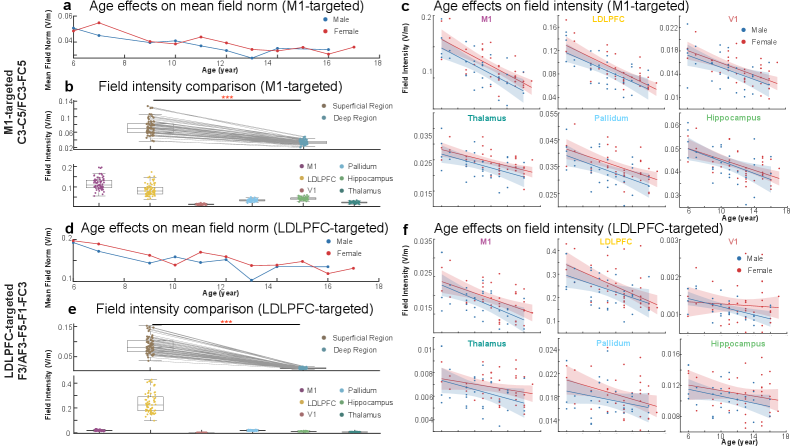
- Conventional montages show significant age-dependent reductions in target intensity (p<0.05, FDR-corrected) and systematic sex differences mediated by scalp volume (mediation effect p<0.05).
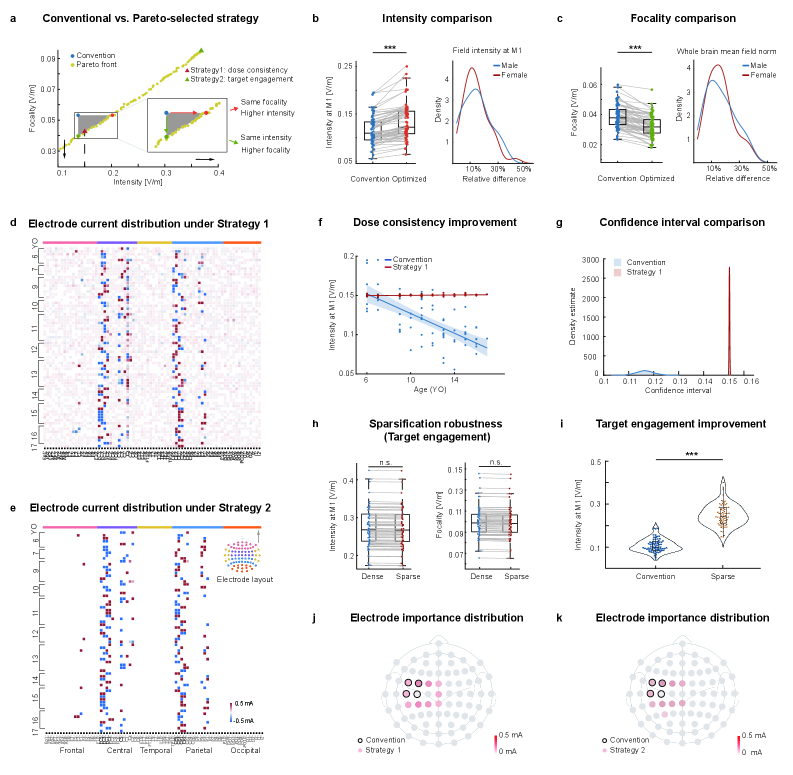
- Optimized solutions Pareto-dominate conventional approaches, achieving 15-25% higher focality at matched intensity and 20-30% higher intensity at matched focality (Mann-Whitney U, p<0.001).
- Both optimization strategies remain robust under large conductivity variations (1,800 optimizations across 600 perturbed models), with sparse electrode configurations (<0.1 mA threshold) preserving performance (n.s., Mann-Whitney U).
摘要: High-definition transcranial direct current stimulation (HD-tDCS) dosing in children remains largely empirical, relying on one-size-fits-all protocols despite rapid developmental changes in head anatomy and tissue properties that strongly modulate how transcranial currents reach the developing brain. Using 70 pediatric head models (ages 6–17) and commonly used cortical targets (primary motor cortex and left dorsolateral prefrontal cortex), our forward simulations find that standard montages produce marked age-dependent reductions in target electric-field intensity and systematic sex differences linked to tissue-volume covariation, underscoring the profound limitations of conventional uniform montages. To overcome these limitations, we introduce a developmentally informed, dual-objective optimization framework designed to generate personalized Pareto fronts summarizing the trade-off between electric-field intensity and focality. These subject-specific fronts reveal systematic performance improvements over conventional montages, yielding both higher focality at matched target intensity and higher intensity at matched focality. From these optimized solutions, we derive two clinically practical dosing prescriptions: a dose-consistency strategy that, for the first time, explicitly enforces fixed target intensity across individuals to implicitly mitigate demographic effects, and a target-engagement strategy that maximizes target intensity under safety limits. Both strategies remain robust to large conductivity variations, and we further show that dense HD-tDCS solutions admit sparse equivalents without performance loss under the target-engagement strategy. Across 1,800 optimizations in 600 conductivity-perturbed head models, we also find that tissue conductivity sensitivity is depth-dependent, with Pareto-front distributions for superficial cortical targets most influenced by gray matter, scalp, and bone conductivities, and those for a deep target predominantly shaped by gray and white matter conductivities. Together, these results establish a principled framework for pediatric HD-tDCS planning that explicitly accounts for developmental anatomy and physiological uncertainty, enabling reliable and individualized neuromodulation dosing in vulnerable pediatric populations.