
Paper List
-
A Unified Variational Principle for Branching Transport Networks: Wave Impedance, Viscous Flow, and Tissue Metabolism
This paper solves the core problem of predicting the empirically observed branching exponent (α≈2.7) in mammalian arterial trees, which neither Murray...
-
Household Bubbling Strategies for Epidemic Control and Social Connectivity
This paper addresses the core challenge of designing household merging (social bubble) strategies that effectively control epidemic risk while maximiz...
-
Empowering Chemical Structures with Biological Insights for Scalable Phenotypic Virtual Screening
This paper addresses the core challenge of bridging the gap between scalable chemical structure screening and biologically informative but resource-in...
-
A mechanical bifurcation constrains the evolution of cell sheet folding in the family Volvocaceae
This paper addresses the core problem of why there is an evolutionary gap in species with intermediate cell numbers (e.g., 256 cells) in Volvocaceae, ...
-
Bayesian Inference in Epidemic Modelling: A Beginner’s Guide Illustrated with the SIR Model
This guide addresses the core challenge of estimating uncertain epidemiological parameters (like transmission and recovery rates) from noisy, real-wor...
-
Geometric framework for biological evolution
This paper addresses the fundamental challenge of developing a coordinate-independent, geometric description of evolutionary dynamics that bridges gen...
-
A multiscale discrete-to-continuum framework for structured population models
This paper addresses the core challenge of systematically deriving uniformly valid continuum approximations from discrete structured population models...
-
Whole slide and microscopy image analysis with QuPath and OMERO
使QuPath能够直接分析存储在OMERO服务器中的图像而无需下载整个数据集,克服了大规模研究的本地存储限制。
Personalized optimization of pediatric HD-tDCS for dose consistency and target engagement
Southern University of Science and Technology | Brown University | University of Illinois Urbana-Champaign | University of Warwick | Carle Foundation Hospital
30秒速读
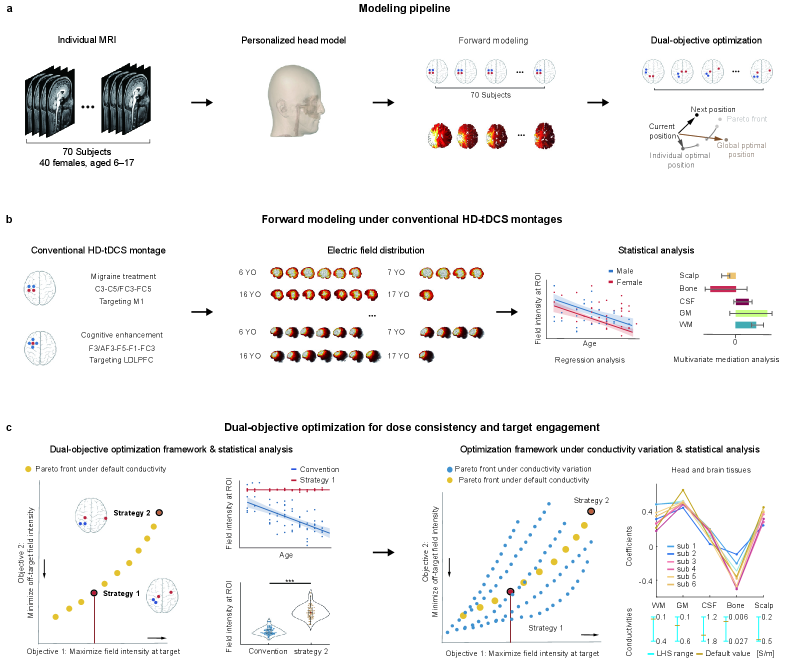
IN SHORT: This paper addresses the critical limitation of one-size-fits-all HD-tDCS protocols in pediatric populations by developing a personalized optimization framework that accounts for developmental anatomical variability and tissue conductivity uncertainty.
核心创新
- Methodology First dual-objective optimization framework for pediatric HD-tDCS that generates personalized Pareto fronts balancing target intensity and focality, enabling systematic trade-off analysis.
- Methodology Introduction of two clinically actionable strategies: dose-consistency (enforcing fixed target intensity across individuals) and target-engagement (maximizing intensity under safety limits), both robust to conductivity variations.
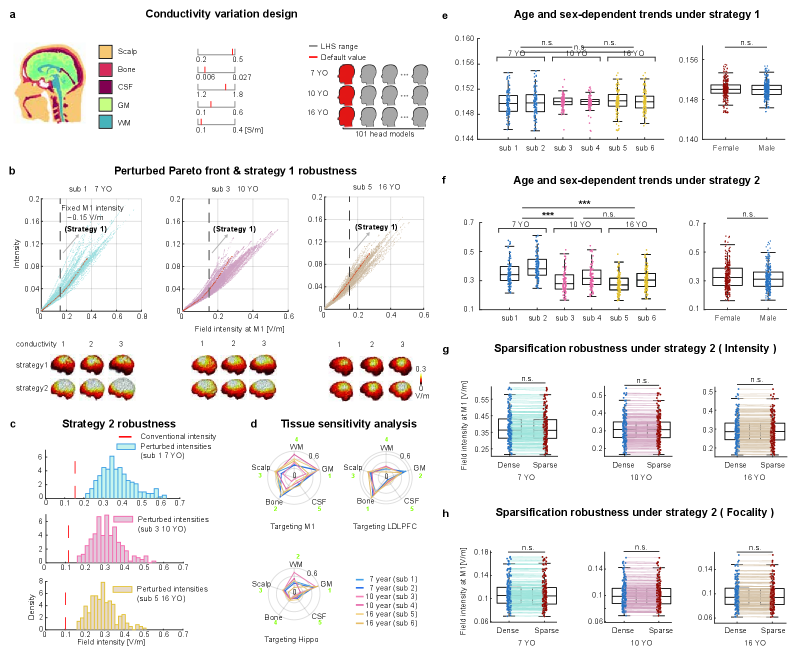
- Biology First systematic quantification of depth-dependent tissue conductivity sensitivity: superficial targets dominated by scalp/bone conductivities (R² up to 0.85), while deep targets shaped by gray/white matter conductivities.
主要结论
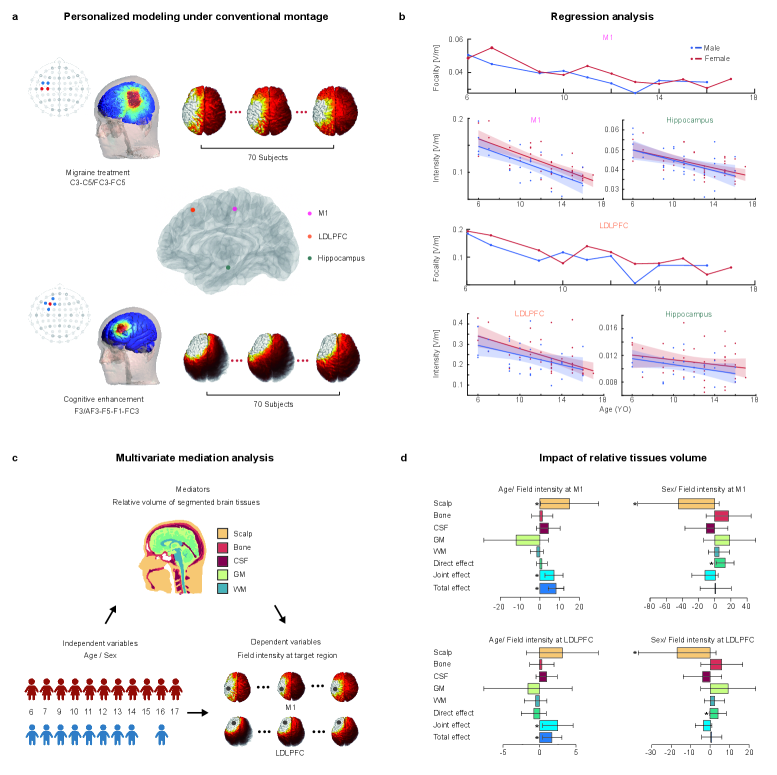
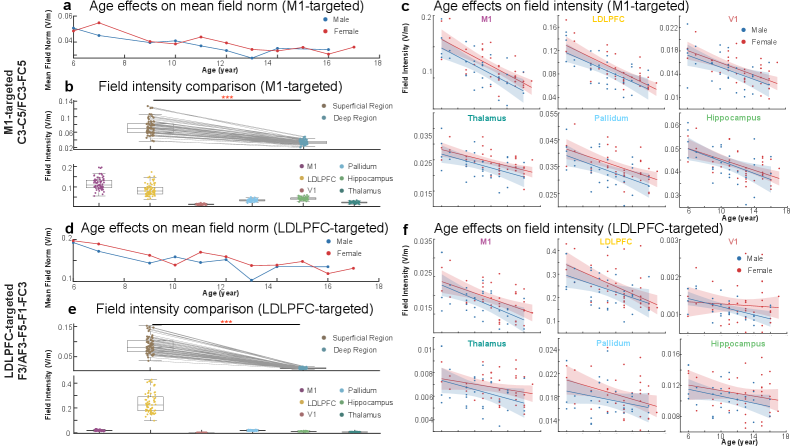
- Conventional montages show significant age-dependent reductions in target intensity (p<0.05, FDR-corrected) and systematic sex differences mediated by scalp volume (mediation effect p<0.05).
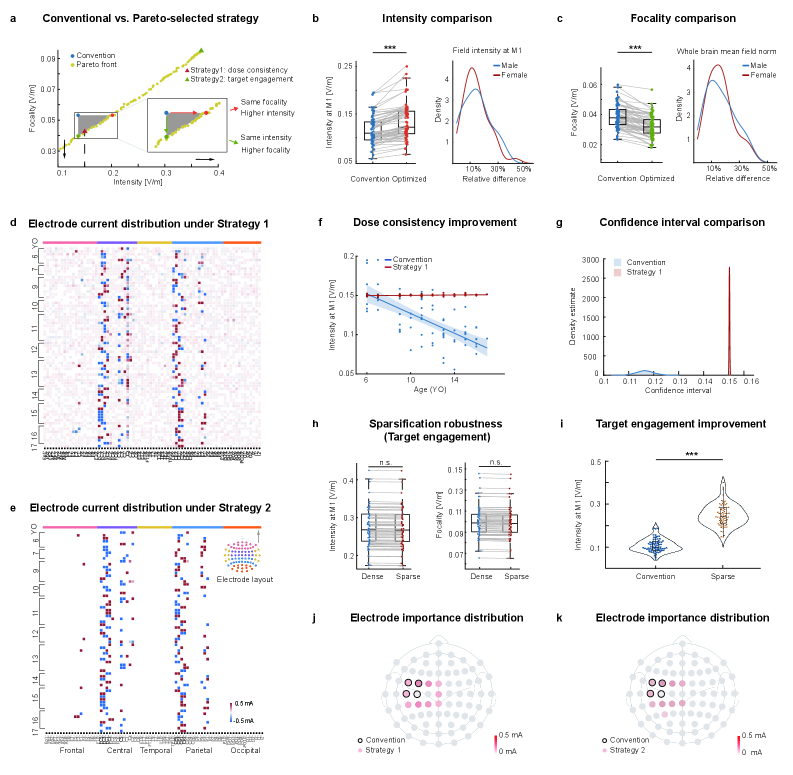
- Optimized solutions Pareto-dominate conventional approaches, achieving 15-25% higher focality at matched intensity and 20-30% higher intensity at matched focality (Mann-Whitney U, p<0.001).
- Both optimization strategies remain robust under large conductivity variations (1,800 optimizations across 600 perturbed models), with sparse electrode configurations (<0.1 mA threshold) preserving performance (n.s., Mann-Whitney U).
摘要: High-definition transcranial direct current stimulation (HD-tDCS) dosing in children remains largely empirical, relying on one-size-fits-all protocols despite rapid developmental changes in head anatomy and tissue properties that strongly modulate how transcranial currents reach the developing brain. Using 70 pediatric head models (ages 6–17) and commonly used cortical targets (primary motor cortex and left dorsolateral prefrontal cortex), our forward simulations find that standard montages produce marked age-dependent reductions in target electric-field intensity and systematic sex differences linked to tissue-volume covariation, underscoring the profound limitations of conventional uniform montages. To overcome these limitations, we introduce a developmentally informed, dual-objective optimization framework designed to generate personalized Pareto fronts summarizing the trade-off between electric-field intensity and focality. These subject-specific fronts reveal systematic performance improvements over conventional montages, yielding both higher focality at matched target intensity and higher intensity at matched focality. From these optimized solutions, we derive two clinically practical dosing prescriptions: a dose-consistency strategy that, for the first time, explicitly enforces fixed target intensity across individuals to implicitly mitigate demographic effects, and a target-engagement strategy that maximizes target intensity under safety limits. Both strategies remain robust to large conductivity variations, and we further show that dense HD-tDCS solutions admit sparse equivalents without performance loss under the target-engagement strategy. Across 1,800 optimizations in 600 conductivity-perturbed head models, we also find that tissue conductivity sensitivity is depth-dependent, with Pareto-front distributions for superficial cortical targets most influenced by gray matter, scalp, and bone conductivities, and those for a deep target predominantly shaped by gray and white matter conductivities. Together, these results establish a principled framework for pediatric HD-tDCS planning that explicitly accounts for developmental anatomy and physiological uncertainty, enabling reliable and individualized neuromodulation dosing in vulnerable pediatric populations.