
Paper List
-
Evolutionarily Stable Stackelberg Equilibrium
通过要求追随者策略对突变入侵具有鲁棒性,弥合了斯塔克尔伯格领导力模型与演化稳定性之间的鸿沟。
-
Recovering Sparse Neural Connectivity from Partial Measurements: A Covariance-Based Approach with Granger-Causality Refinement
通过跨多个实验会话累积协方差统计,实现从部分记录到完整神经连接性的重建。
-
Atomic Trajectory Modeling with State Space Models for Biomolecular Dynamics
ATMOS通过提供一个基于SSM的高效框架,用于生物分子的原子级轨迹生成,弥合了计算昂贵的MD模拟与时间受限的深度生成模型之间的差距。
-
Slow evolution towards generalism in a model of variable dietary range
通过证明是种群统计噪声(而非确定性动力学)驱动了模式形成和泛化食性的演化,解决了间接竞争下物种形成的悖论。
-
Grounded Multimodal Retrieval-Augmented Drafting of Radiology Impressions Using Case-Based Similarity Search
通过将印象草稿基于检索到的历史病例,并采用明确引用和基于置信度的拒绝机制,解决放射学报告生成中的幻觉问题。
-
Unified Policy–Value Decomposition for Rapid Adaptation
通过双线性分解在策略和价值函数之间共享低维目标嵌入,实现对新颖任务的零样本适应。
-
Mathematical Modeling of Cancer–Bacterial Therapy: Analysis and Numerical Simulation via Physics-Informed Neural Networks
提供了一个严格的、无网格的PINN框架,用于模拟和分析细菌癌症疗法中复杂的、空间异质的相互作用。
-
Sample-Efficient Adaptation of Drug-Response Models to Patient Tumors under Strong Biological Domain Shift
通过从无标记分子谱中学习可迁移表征,利用最少的临床数据实现患者药物反应的有效预测。
ANNE Apnea Paper
University of Toronto Department of Medicine, Computer Science | Sunnybrook Research Institute Department of Medicine Neurology Div.
30秒速读
IN SHORT: This paper addresses the core challenge of achieving accurate, event-level sleep apnea detection and characterization using a non-intrusive, multimodal wearable device, moving beyond simple recording-level AHI prediction.
核心创新
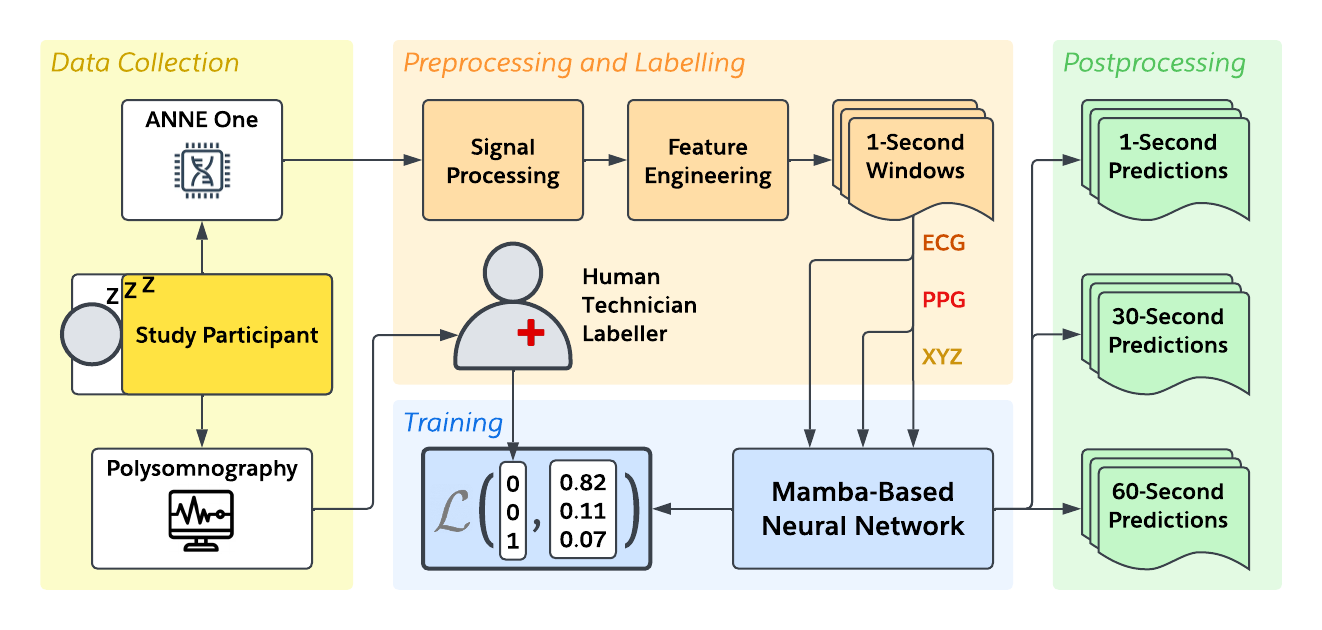
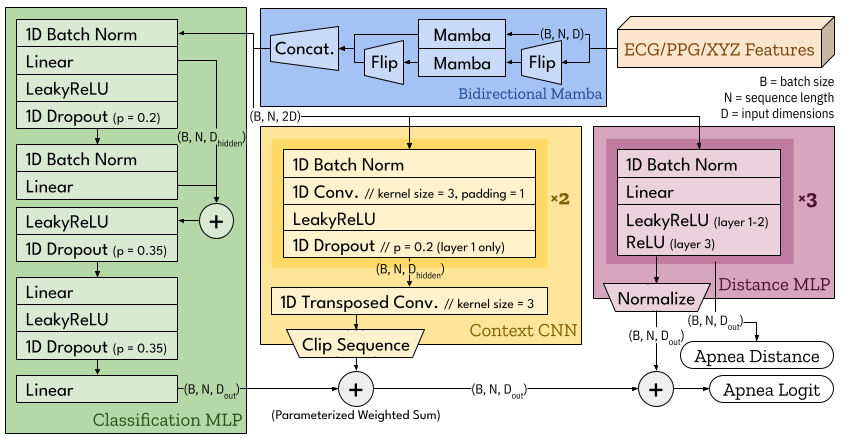
- Methodology Proposes a novel Mamba-based deep sequential neural network architecture, integrating a classification MLP, a context CNN for local patterns, and a distance MLP for event localization, inspired by YOLO for multi-task learning.
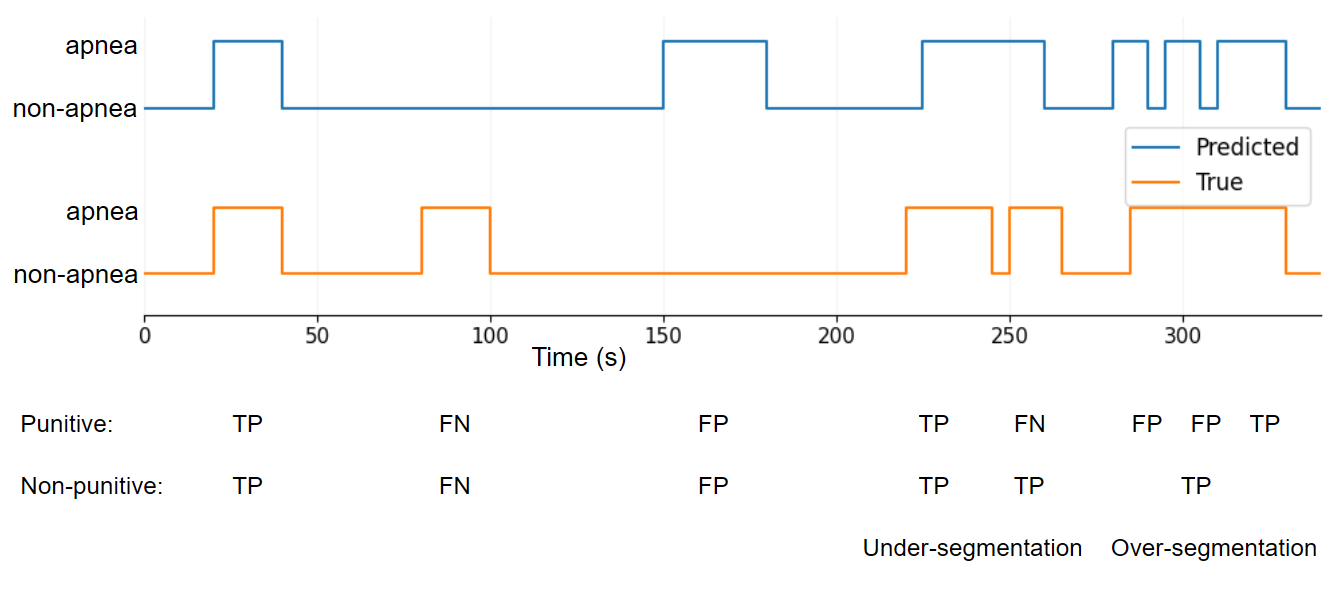
- Methodology Introduces a comprehensive event-wise evaluation framework for apnea detection models, moving beyond traditional segment-wise metrics to quantify true positives, false positives, and false negatives based on event overlap (IoU).
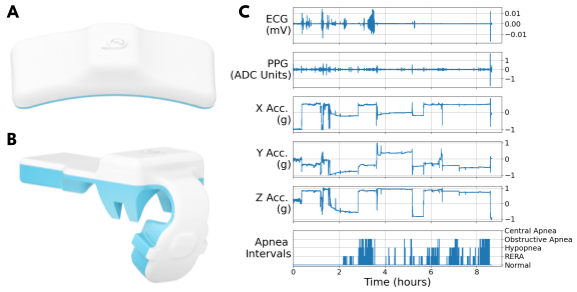
- Biology/Application Demonstrates the application of the Mamba architecture on a rich, multimodal dataset from the ANNE One wearable (ECG, accelerometry, temperature, PPG) from an older, clinically diverse cohort (mean age 56), testing robustness in realistic, noisy conditions.
主要结论
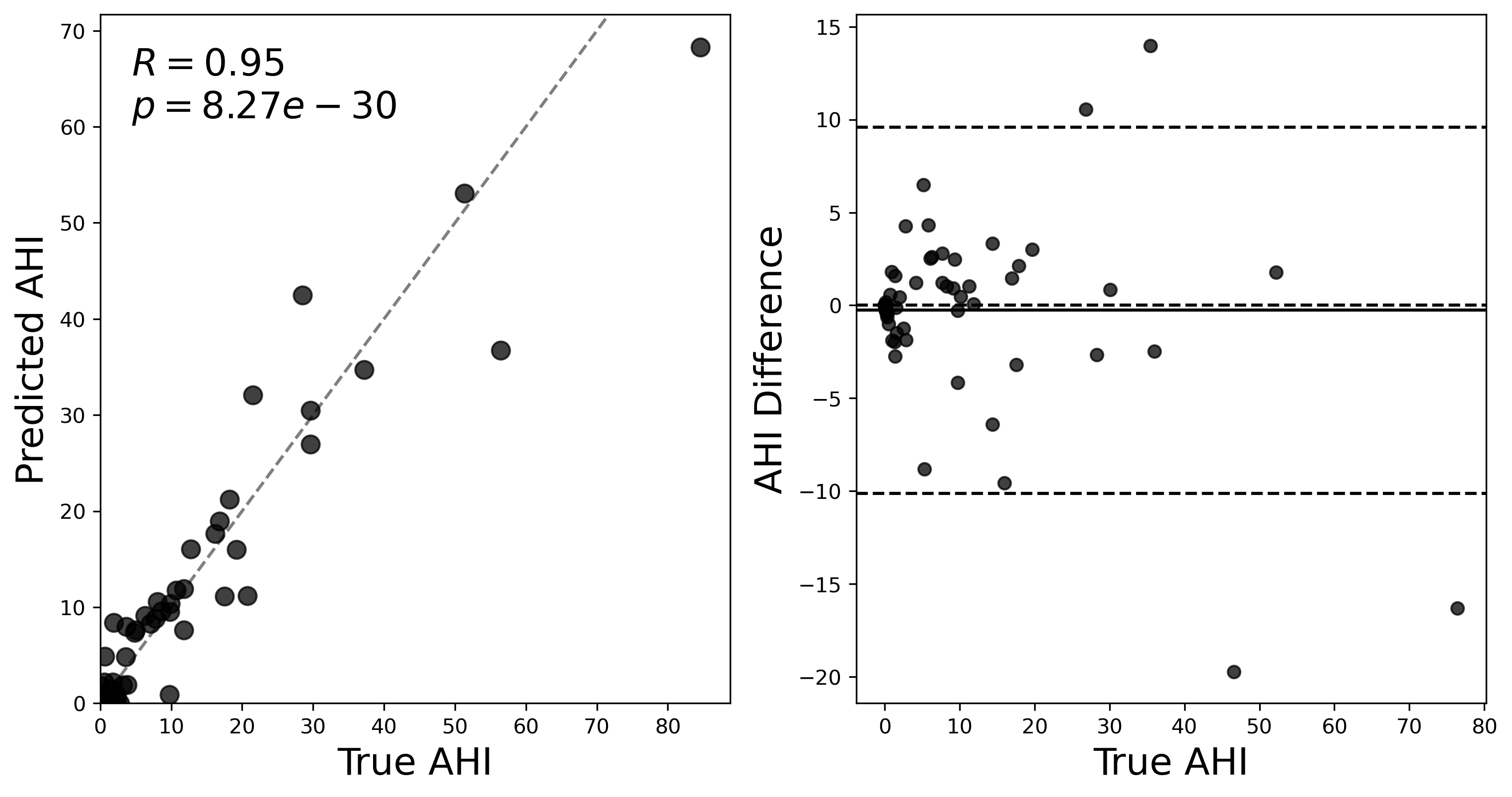
- The model-predicted AHI showed a very high correlation with PSG-derived AHI (R=0.95, p=8.3e-30) with a mean absolute error of 2.83 events/hour.
- At the 30-second epoch level, the model achieved high sensitivity (0.93) and specificity (0.95) for detecting epochs containing any respiratory event.
- The model demonstrated capability in event-type characterization, correctly classifying 77% of central apneas and 95% of other respiratory events (RERA/Hypopnea/Obstructive).
摘要: Objectives: In-laboratory polysomnography (PSG) is the reference standard for the diagnosis of sleep disordered breathing, and characterization of disease physiology along multiple dimensions. However, it is labour intensive, poorly scalable, and can perturb sleep. Numerous devices for home sleep apnea testing (HSAT), along with tools for automated analysis, have been developed to address these limitations. Although several such tools have shown good performance at establishing a diagnosis of SDB at the recording level, most have uncertain performance at the individual event level, including differentiation of event type (e.g. central vs. obstructive apneas), and determination of precise event timing. Moreover, while disruption of sleep architecture is a key feature of sleep disordered breathing, not all HSAT devices are able to return epoch-by-epoch sleep staging. Here we present and evaluate a deep-learning model for diagnosis and event-level characterization of sleep disordered breathing based on signals from the ANNE One, a non-intrusive dual-module wireless wearable system measuring chest electrocardiography, triaxial accelerometry, chest and finger temperature, and finger phototplethysmography. Methods: We obtained concurrent PSG and wearable sensor recordings from 384 adults attending a tertiary care sleep laboratory. Respiratory events in the PSG were manually annotated in accordance with AASM guidelines. Wearable sensor and PSG recordings were automatically aligned based on the ECG signal, alignment confirmed by visual inspection, and PSG-derived respiratory event labels were used to train and evaluate a deep sequential neural network based on the Mamba architecture. Results: In 57 recordings in our test set (mean age 56, mean AHI 10.8, 43.86% female) the model-predicted AHI was highly correlated with that derived form the PSG labels (R=0.95, p=8.3e-30, men absolute error 2.83). This performance did not vary with age or sex. At a threshold of AHI >5, the model had a sensitivity of 0.96, specificity of 0.87, and kappa of 0.82, and at a threshold of AHI >15, the model had a sensitivity of 0.86, specificity of 0.98, and kappa of 0.85. At the level of 30-sec epochs, the model had a sensitivity of 0.93 and specificity of 0.95, with a kappa of 0.68 regarding whether any given epoch contained a respiratory event. Among 3,555 detected respiratory events, and contrasting central apneas from other events, the model correctly classified 77% of central apneas and 95% of RERA/Hyp/Obs. Moreover, model predicted mean respiratory event duration was moderately correlated with PSG-derived event duration (R=0.53, p=4.9e-3). Conclusions: Applied to data from the ANNE One, a wireless wearable sensor system without sensors on the face or the head, a Mamba-based deep learning model can accurately predict AHI and identify SDB at clinically relevant thresholds, achieves good epoch- and event-level identification of individual respiratory events, and shows promise at physiological characterization of these events including event type (central vs. other) and event duration.